
Automated Borders, e-Gates and Kiosks – How EES is Accelerating the Global Transformation of Border Control
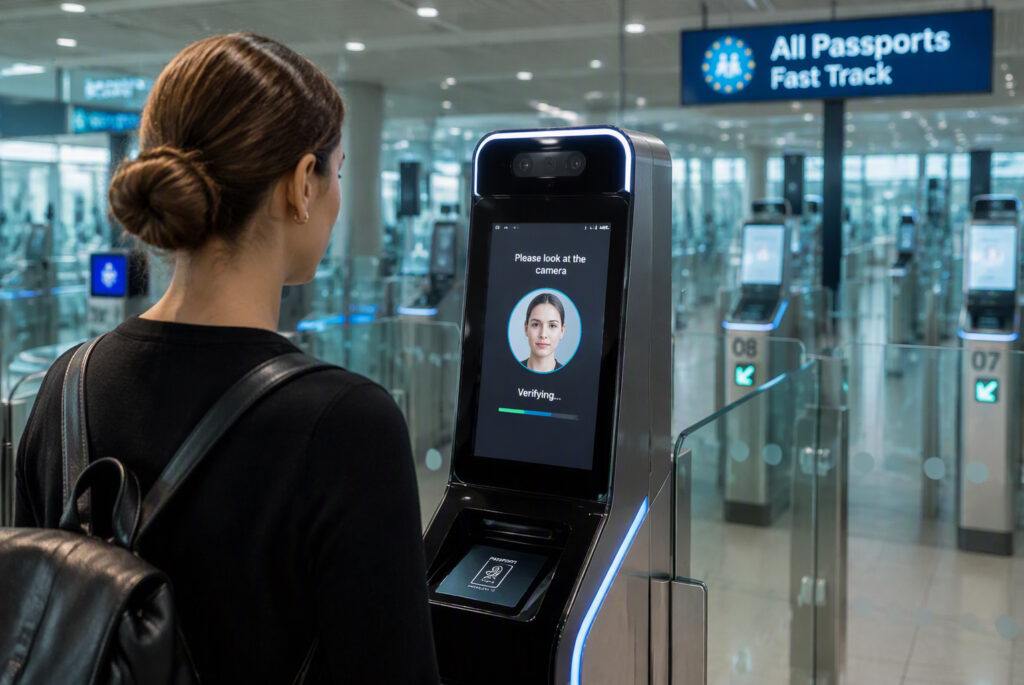
The implementation of the European Union’s Entry/Exit System (EES) has become the single most important driver of investment in border automation technology anywhere in the world. Since becoming fully operational across the Schengen Area in April 2026, EES has fundamentally altered how European states manage their external borders. The system replaces manual passport stamping with the electronic registration of traveller movements, recording biographic information, facial images and biometric data while enabling the automatic identification of overstayers and individuals attempting identity fraud. European authorities have openly acknowledged that EES is intended to support wider use of automated border controls and self-service systems across air, land and maritime border crossings.
For border agencies, airports and governments, EES is far more than a regulatory requirement. It represents a catalyst for the rapid deployment of automated border control (ABC) technologies, including self-service enrolment kiosks, biometric e-Gates, mobile enrolment systems and cloud-based identity management platforms. For suppliers, it has created one of the largest procurement opportunities seen in border security for decades.
While Europe currently dominates the discussion, the technologies underpinning EES are not entirely new. Many of the concepts now being deployed at European borders were pioneered in the United States, Canada, Australia and Singapore. What makes EES unique is not the technology itself but the scale. Never before has a regional bloc attempted to standardise biometric border processing across almost thirty countries using a single legal and technical framework.
The New Border Architecture
Historically, most travellers arriving in Europe presented a passport to a border officer who conducted document inspection and manually stamped the travel document. EES changes that process dramatically.
First-time travellers entering the Schengen Area must provide biometric data, including facial images and, where applicable, fingerprints. This creates significant operational challenges, particularly at large airports already processing tens of millions of passengers annually. Without automation, border authorities would struggle to meet throughput requirements while maintaining acceptable service levels.
The solution has been the widespread adoption of automated border infrastructures. Increasingly, travellers begin the process at self-service kiosks where passports are scanned, biometric data collected and identity checks performed before they arrive at primary inspection points. They then proceed through biometric e-Gates or are directed to officers for additional inspection when required.
The border officer remains part of the process but increasingly acts as an exception handler rather than the primary processor of every traveller.
Understanding the Supplier Market
The automated border industry is often misunderstood because suppliers perform very different roles. Some manufacturers produce physical kiosks and gates. Others specialise in biometrics or digital identity technologies. A third category focuses primarily on systems integration.
Manufacturers of Kiosks and e-Gates
Among the genuine manufacturers of border kiosks and automated gates, several companies dominate the global market.
IDEMIA remains one of the most influential suppliers in the ABC sector. The company designs and manufactures both self-service kiosks and automated e-Gates while also supplying biometric and identity verification technologies. IDEMIA systems can be found throughout Europe, North America, the Middle East and Asia, with deployments at major hubs including Paris Charles de Gaulle and Amsterdam Schiphol.
Vision-Box, now part of Amadeus, is another major manufacturer. The company’s portfolio includes biometric enrolment kiosks, automated border gates and end-to-end passenger journey platforms. Vision-Box has been heavily involved in automated border deployments at airports in Europe, Latin America, the Gulf and North America.
secunet, best known for Germany’s EasyPASS programme, manufactures border kiosks, enrolment stations and gate systems specifically designed for government border agencies. The company has become particularly important in EES-related projects across Germany and neighbouring states.
Gunnebo Entrance Control and Dormakaba also offer automated access-control platforms and gate systems that can be incorporated into border processing environments.
The Biometric Specialists
Behind every automated border system sits a biometric engine.
Dermalog specialises in fingerprint and facial recognition technologies and has developed a substantial presence within government identity and border-management projects.
Thales has become one of the world’s most important border technology suppliers through its combination of biometrics, digital identity management, document verification and integrated border-management solutions.
Veridos, the German identity specialist, has similarly built a strong presence through electronic passports, identity credentials and secure border technologies.
Japanese company NEC has secured numerous contracts supporting airport automation and border modernisation programmes globally.
The Systems Integrators
Not every company associated with border kiosks manufactures the hardware itself.
SITA remains one of the most influential players in global border automation, but its primary role is that of a systems integrator. The company reports deployments of more than 5,500 border kiosks worldwide and provides an integrated ecosystem covering biometric enrolment, passenger flow management, traveller identity orchestration and automated clearance systems. Rather than focusing solely on hardware manufacturing, SITA’s strength lies in connecting government systems, airport infrastructure and airline operations into a single operational environment.
Materna Intelligent Passenger Solutions (IPS) is similarly better understood as a passenger-processing specialist and integrator. While it delivers kiosk-based solutions, its expertise centres on workflow design, deployment, software integration and passenger experience rather than the manufacture of proprietary border-control hardware.
Indra and Travizory increasingly occupy comparable positions, providing the software and identity-management frameworks that allow governments to integrate multiple technologies into a functioning border ecosystem.
Unlike traditional e-Gate and kiosk suppliers, Travizory focuses on digital border management, using AI, biometrics and traveller intelligence to enable risk assessment and decision-making before a traveller reaches the border.
The United States: The World’s Largest Biometric Border Programme
If Europe represents the future of automated borders, the United States represents the most mature large-scale deployment.
For more than a decade, U.S. Customs and Border Protection (CBP) has pursued one of the most ambitious biometric border programmes ever undertaken. Unlike Europe’s heavy reliance on e-Gates, the American model is primarily based on facial biometric verification integrated directly into border processing workflows.
Today, travellers arriving at major international airports frequently undergo facial verification rather than traditional document inspection. Images are matched against government-held records within seconds, enabling rapid identity confirmation while reducing officer workload.
The programme extends well beyond arrival halls. Biometric verification is now increasingly embedded within departure environments, seaports and land crossings.
This strategy has created substantial opportunities for companies including IDEMIA, NEC, Thales, Collins Aerospace and Vision-Box, all of which have participated in various elements of U.S. border modernisation programmes.
The American experience has also demonstrated that biometric processing can be scaled nationally. Europe’s EES architects have watched these developments closely, particularly regarding passenger throughput, privacy protection and operational resilience.
Global Entry: A Blueprint for Trusted Traveller Automation
Long before EES entered development, the United States was refining trusted traveller programmes through Global Entry.
Initially based around self-service immigration kiosks, Global Entry allowed pre-vetted travellers to complete border formalities quickly and efficiently. The programme proved that low-risk passengers could be processed largely through automated systems without compromising security.
Many subsequent programmes worldwide borrowed heavily from this model, including Canada’s NEXUS initiative, Australia’s SmartGate programme and various European trusted traveller schemes.
Canada’s Home-Grown Kiosk Industry
Canada occupies a unique position in border automation because it has produced two of North America’s most significant indigenous kiosk manufacturers.
The first is Embross, based in Toronto. The company’s VelocityOnePIK platform was developed specifically to support the Canada Border Services Agency’s Primary Inspection Kiosk programme and has been deployed at airports including Calgary, Ottawa, Edmonton and Billy Bishop Toronto City Airport. Its systems incorporate passport-reading technology, biometric facial imaging and fingerprint capture capabilities.
The second is Innovative Travel Solutions (ITS), a business unit of Vancouver International Airport. ITS developed the highly successful BorderXpress platform, one of the most widely deployed border kiosk systems globally. The company expanded BorderXpress to support CBSA’s Primary Inspection Kiosk programme and has reported deployments exceeding 1,000 kiosks worldwide.
Unlike many border technology suppliers, both organisations emerged directly from the Canadian aviation sector, proving that border innovation does not necessarily originate from the traditional defence industry.
South America: A Rapidly Expanding Market
While less frequently discussed than Europe or North America, South America has quietly become one of the fastest-growing regions for automated border control technologies.
Brazil has emerged as the continent’s largest market, driven by growing passenger numbers and major airport modernisation programmes. Airports in São Paulo, Rio de Janeiro and Brasília have increasingly adopted biometric processing technologies supplied by international providers including IDEMIA and NEC.
Argentina has also invested steadily in immigration automation, while Chile’s strength in digital government services has supported broader adoption of biometric identity technologies.
Colombia, Peru and several Central American states are pursuing similar initiatives as aviation traffic continues to increase throughout the region.
Perhaps most significantly, many tourism-dependent economies across the Caribbean have recognised that rapid border processing is not merely a security issue but a commercial necessity. Faster border clearance improves passenger experience and enhances competitiveness in attracting international visitors.
Beyond EES
The real significance of EES is not that it introduces biometrics to Europe’s borders. Those technologies already exist and are widely deployed. The importance of EES lies in creating the world’s largest interoperable automated border environment.
The technologies developed by IDEMIA, Vision-Box, Embross, BorderXpress, secunet, NEC, Thales, Veridos, SITA and numerous others are converging toward a future in which biometric identity becomes the primary credential used for border crossing.
Within the next decade, kiosks may evolve into mobile enrolment platforms, digital travel credentials may reduce dependence on physical passports and biometric verification could begin before a traveller even arrives at a border crossing.
For border agencies, the objective remains unchanged: stronger security combined with faster processing. EES is not the destination. It is the platform upon which the next generation of automated borders will be built.
By: Tony Kingham, Editor, Border Security Report