Beyond the digital border, and why the next evolution might surprise you
Human innovation is littered with instances of biomimicry, where nature’s ingenious design is replicated to solve for increasingly complex human challenges. High-speed bullet trains in Japan were inspired by the streamlined Kingfisher bird, while termite mounds moved architects in Zimbabwe to design sustainable, self-cooling structures.
In the business of borders, there’s a lot we can learn from the industrious ant.
Ants are orderly. They are efficient. And their execution is seamless. With row upon row of individual ants rushing backwards and forwards across narrow connected pathways en route to a single destination – the ant is possibly the closest natural example of how best to manage crowded queues and surging lines of human traffic. People gathering, for instance, at an international airport or a centralised immigration control point.
Researchers from France, the USA and Australia have studied ant behaviour for this very reason: to understand how, even when things get crowded, ants just keep on moving.
The answer, it seems, has a lot to do with an ant’s ability to self-regulate its behaviour by cooperating, slowing down, or creating new traffic lanes when density demands it. In many respects, this is not unlike the digitally interconnected human travel ecosystem that is currently taking root around the world. Only in our human world do we have the luxury of being able to add a skin of additional protection in the form of advanced digital technology.
Like ant colonies – where the security of the nest and its inhabitants is critical – safety is also the guiding principle behind any digital border system. However, that’s not the only consideration. Efficiency is just as important for us humans as it is for our ant counterparts, maybe more so.
Corralling billions upon billions of airline passengers a year through under-resourced and constrained immigration and customs control points must consider more than just the common good. We also need to cater to the likes, dislikes, needs and complexities of every single individual traveller.
With the International Air Transport Association (IATA) estimating that , by 2043, the number of global air passengers will hit eight billion, humans certainly need efficient digital systems to replicate the chemical communications and collective behaviour of a disciplined ant colony. It’s the only way we can hope to achieve the consistently high level of identity management and threat detection required to manage global travel at a level never before witnessed in human history.
Unlike in our ant analogy, it’s here that the human story gets more complicated. Specifically, there are three additional drivers that we need to think about very carefully:
- the changing face of global threats,
- a glaring lack of resources, and
- a growing global appetite for convenient, self-directed travel and border crossing.
Considering each in turn, it is increasingly clear that as passenger numbers increase, each of these drivers will ratchet up the pressure. This will turn what is currently a firm push towards biometric-enabled digital borders into an existential game-changer for national security, economic development, tourism, and effective threat detection and prevention.
Keeping pace with fast-changing global threats
Border security, the verification of visitor identities, and ensuring the integrity and authenticity of travel documentation were among the driving forces behind Malaysia becoming the first country in the world to issue a biometric electronic passport in 1998. At the time, this was truly revolutionary and a move that soon saw others follow. By 2025, over 140 countries are issuing e-passports.
Around the same time, the first Electronic Travel Authorisation (ETA) systems were rolled out, enabling trailblazers like Australia and Singapore to replace paper visas with online travel permissions for tourists or business travellers. While in the United States, the first semi-automated facial recognition system was deployed in Los Angeles as a way to search through digitized mugshots.
From there, things mushroomed in the 2000s as automated biometric border solutions were used to process billions of transactions at the 2000 Sydney Olympic Games, the 2004 Bahrain Formula One Grand Prix, the 2010 FIFA Soccer World Cup in South Africa, and the 2014 FIFA World Cup in Brazil. The arrival of the smartphone in 2001 and, more recently, the potential for Large Language Models and Artificial Intelligence (AI) added more exciting technologies to the mix. Today, the range of advanced technologies that work together to facilitate smarter, safer borders spans digital identities, biometric authentication, seamless data exchange, and risk assessments powered by AI.
However, as the world has become more interconnected – and, quite frankly, smaller and easier to circumnavigate – what started as border enhancement and security support has become a necessity for governments under growing pressure to counter emerging security threats. Not just national security, but terrorism, human trafficking, organised crime, and – since the Covid-19 pandemic – global health threats. Digital borders effectively move the parameters of existing border management away from a country’s physical border to the time of booking a ticket, or the moment a passenger applies for digital pre-clearance in the form of an eVisa, traditional entry visa, or ETA.
This might not sound like a big deal, but it is.
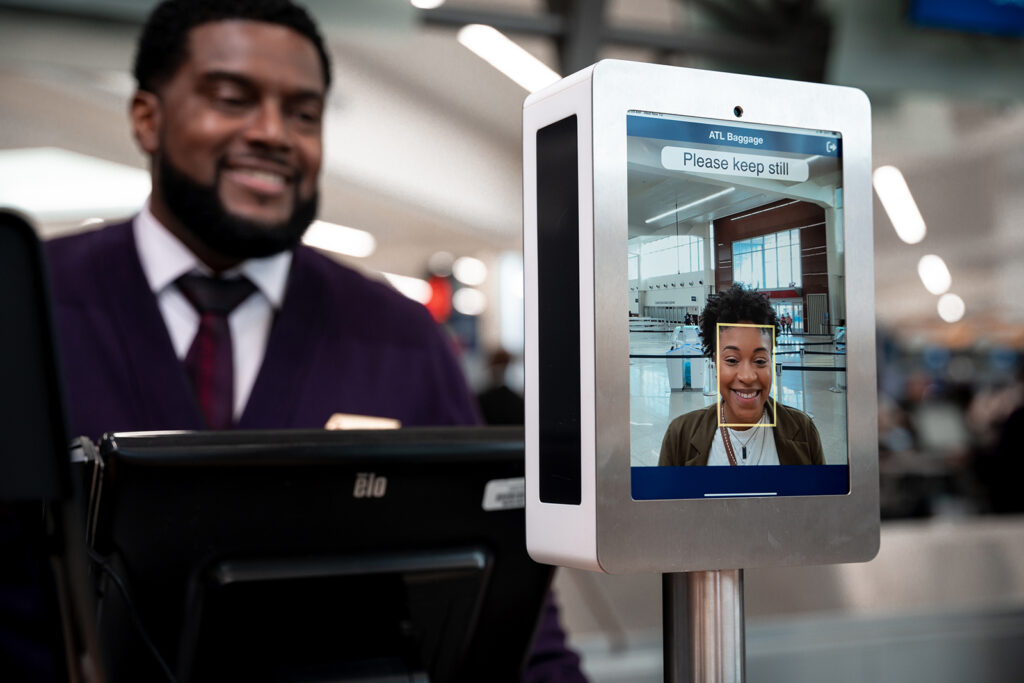
A digital border gives governments, border officials, and airlines the time they need to carefully cross-check and confirm passenger details and, if necessary, conduct security checks. With so much of this process now leveraging automated systems and biometric checks – and, more recently, the use of smartphones for self-capturing facial biometrics – this equates to reduced workloads and pressure on border staff. In reality that means a smarter, faster, and more secure border – with fewer queues. It means low-risk travellers can get on with their holidays or business meetings, while border guards focus on the real, high-risk threats.
Enabling talent, not fighting for resources
The challenge, however, is that as threats become smarter and more pervasive, major transport hubs like airports are facing a capacity shortfall of 1.5 billion by 2040. The aviation industry as a whole will be short of 1.6 million people by 2030. Governments are also battling to fill critical border officer vacancies, with many countries – including the United Kingdom – dealing with significant understaffing as they struggle to find new recruits.
This is not just a people challenge but a matter of space constraints. For instance, a major airport like Heathrow in London has been operating at 98% capacity for over a decade and is battling to get expansion plans off the ground due to financial considerations and environmental and community concerns. That’s another resource headache.
One solution is to keep building bigger and bigger infrastructure projects and beefing up staffing levels to prop up outdated systems that are no longer fit for purpose. The smarter move is to shift towards modern, digital border solutions, which is exactly what has been happening for the past 20 years.
Appetite for digital identities and digital travel
Between 2004 and 2028, it is expected that around 5.6 trillion biometric digital identity transactions will take place globally. This represents an anticipated market of some US$315 billion in digital transformation revenue, but it’s the game-changing potential of this digital future that is the real drawcard.
For governments and border officials, that future might involve smoothing the way for visitors, improving efficiencies, ensuring regulatory compliance, and putting strong safeguards in place to identify potential threats. But there is also the human experience to consider, and that’s where things are getting increasingly interesting.
Having experienced what digital solutions mean for a safer, less stressful journey, people are hungry for more. According to IATA’s 2024 Global Passenger Survey, 73% of passengers favour using biometric data to board a flight and to pass through immigration. Of those surveyed, nearly half made use of biometric solutions at an airport in 2024, while 45% were keen to get all their immigration red tape out of the way before arriving to take their flight. This is particularly true of the younger generations, the 20-to-40-year old Millennials and Generation Z travellers who fully embrace the digital world they grew up in and much prefer using technology and digital tools at each stage of their travel experience.
For governments, airlines, airports, and tourism providers still debating the merits of investing in digital technology rather than brick-and-mortar solutions, understanding the spending patterns and preferences of modern-day travellers is going to be quite a mindset shift. If we really listen to what passengers are saying, and how they are gravitating towards the likes of digital identities and online loyalty programmes, it’s becoming clearer that the physical infrastructure that defined status and standing just 20 years ago no longer underscores the attractiveness of a destination or the global reputation of a country.
In this respect, one of the most exciting aspects of digital travel transformation is that it gives an up-and-coming African or Asian nation access to the same tools as a world superpower. The only limitation is how each country chooses to innovation within their own digital border ecosystem.
The ultimate leveller
There are a number of countries that could be singled out for their innovative use of digital technology to enhance borders and enable travel and tourism. Singapore is up there. So is the Kingdom of Saudi Arabia. Meanwhile, Australia, the European Union, the United States, and large swathes of Latin America, Africa, and Asia continue to shine.
We are seeing the widespread use of digital technologies to check passenger data, streamline airport and border activities, optimise border agent activities, and combat transnational crime. We are also seeing firmer control of migratory flows and enhanced risk prevention and planning. These we expected, but what is increasingly on our radar is the potential for boosting trade and economic development by attracting and promoting tourism.
This whole dynamic package is being showcased by the Caribbean island of Aruba, which is enhancing its national brand and standing on the world stage by embracing digital solutions and platforms. Aruba was quick to recognise the intrinsic value of digital borders, both financially and in terms of security and goodwill. Yes, they streamlined pre-boarding clearances and at-border processing.
Still, they are also actively finding ways to broaden their digital travel ecosystem beyond the border – creating an interconnected travel experience that continues beyond the border and into a welcoming web of digitally-connected tourism services like hotels, restaurants, conference venues, taxi rides, and car hire platforms. Seemingly, any touchpoint that can be improved through efficient digital solutions has a place in Aruba’s plans for the future.
This is how borders are evolving. What started as rows of ants demonstrating efficiency and organization has now taken on an exciting human-inspired dimension all its own. Yes, we want better borders, but why stop there?
The push and pull factors, the standout possibilities, and the unfolding future of digital borders. By Andy Smith, Director, Industry & Innovation at SITA