Chilean Customs alert allowed the detection of more than 100 shipments associated with poppers to dismantle a clandestine laboratory
Following coordinated work with the PDI (Chilean Investigative Police) and the Western Criminal Analysis Prosecutor’s Office, a group dedicated to the production and distribution of this substance was identified. Three people were arrested, and 685 bottles of poppers were seized, along with controlled chemicals, other drugs, and materials used for its production and packaging.
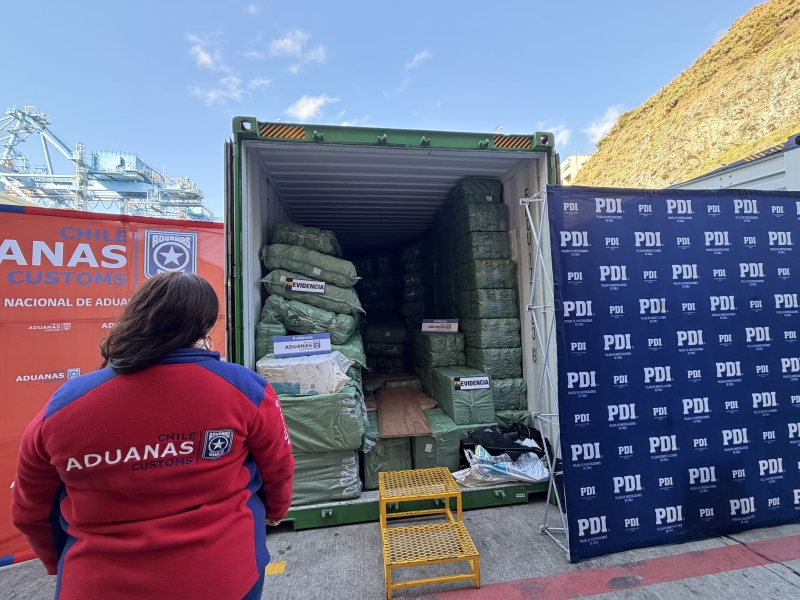
An alert generated by the National Customs Service after detecting a shipment entering the country with bottles, boxes and labels commonly used for packaging poppers, provided the first background information for an investigation that culminated in the discovery of a clandestine laboratory dedicated to the production of this substance in the Valparaíso region.
The discovery was made as part of Customs’ ongoing inspections of these types of products. “For us, it’s common to seize poppers. In the last two years, we’ve confiscated around 10,000 units of this type of product, and this time, our inspectors detected the arrival of bottles, labels, containers, and other items that appeared to be intended for the manufacture of this same type of product,” explained Rodrigo Díaz, Regional Director of Metropolitan Customs.
Following this detection, Customs identified the recipient of the shipment, residing in the Valparaíso Region, and generated a risk profile associated with two individuals who were importing these types of products. Although the items detected were not prohibited goods in themselves, their characteristics and the available information allowed Customs to issue an alert and report the matter to the Investigative Police.
Subsequently, new shipments began to arrive related to jars, lids, labels, and boxes associated with these products.
“We detected more than 100 shipments of this type of product, including bottles, labels, and boxes. Every time a shipment related to these items arrived at the airport, we promptly informed BRISUQ and sent them the relevant information and photographs of the detected items for their review and analysis,” the Regional Director added.
Customs procedures involved opening and inspecting shipments, supported by non-invasive technology, to identify the possible presence of organic substances. However, these inspections did not yield any positive results regarding the detection of such substances.
The information provided by Customs allowed for constant coordination with the PDI during the investigation and contributed to the generation of new alerts related to this type of shipment.
“Interagency collaboration is vital in the fight against organized crime and drug trafficking gangs. Therefore, we are very pleased with the work done,” Rodrigo Díaz emphasized.
Prefect Johnny Fica, Acting National Chief Against Organized Crime of the PDI, highlighted that the investigative result was possible thanks to the joint work between the institutions and especially emphasized the contribution of Customs in the initial detection of the elements used by the organization.
“The National Customs Service managed to detect an import of the basic supplies, particularly the bottles used by this criminal group to manufacture poppers. This investigative result is a joint effort with the Public Prosecutor’s Office, specifically the Western Criminal Analysis Prosecutor’s Office, led by Prosecutor Daniel Contreras,” Fica stated.
Based on the information gathered during the investigation, the PDI and the Prosecutor’s Office were able to establish that those involved acquired various laboratory supplies and chemical substances used for the production of poppers, using front companies to justify the purchase of substances controlled by Law 20,000.
The analysis of bank accounts also allowed investigators to identify buyers of this substance, information that was later corroborated through surveillance. Simultaneously, investigators identified the companies used to acquire the chemicals and were able to determine the location of a clandestine laboratory inside a property in the Quintero district.
For the prosecutor of Criminal Analysis West, Daniel Contreras, the information provided by Customs was especially relevant because it allowed him to realize that elements that at first might seem innocuous were linked to an illicit activity.
“For us as the Public Prosecutor’s Office, it is important to highlight the interagency work. The work that Customs does when detecting items or issues that may appear innocuous, such as bottles or labels, and then leading to an investigation where these bottles and labels could potentially be intended for drug trafficking, is of course relevant,” the prosecutor stated.
Contreras added that the joint effort subsequently allowed them to identify companies and suspects and establish the operation associated with the production and distribution of this substance. “We, as an institution of the Public Prosecutor’s Office dedicated to prosecuting this type of crime, appreciate the information provided to us, as well as the work of the Investigative Police who, after months of investigation, were able to identify companies, suspects, and, essentially, this type of drug that is causing serious harm to public health,” he stated.
With this background, and under the instruction of the Western Criminal Analysis Prosecutor’s Office, the PDI carried out an operation in the communes of Santiago, Concón, Quintero, Villa Alemana and Quilpué.
The procedure led to the arrest of three men of Chilean nationality, aged 35, 36 and 46, all without criminal records.
According to the investigation, two of the accused were involved in the production and distribution of poppers (alkyl nitrites), while during the procedure one of the main buyers of this substance in large volumes was also arrested.
During the operation, 685 bottles of poppers were seized, in addition to various controlled chemical substances, including 8,220 grams of amyl alcohol, 4,100 grams of isoamyl alcohol, 3,265.17 grams of sodium hydroxide, 3,733.29 grams of dichloromethane, 58,960.22 grams of isobutyl alcohol, 1,490.18 grams of ethyl acetate, 1,159.26 grams of ethyl ether, 1,306.39 grams of toluene, 13,930 grams of butyl alcohol, 55,640 grams of isopropyl alcohol, 6,240 grams of sodium nitrite, and 4,910 grams of methanol.
Also seized were 19.38 grams of cannabis, 14.92 grams of psilocybin mushrooms, 47.1 grams of MDMA, 11.82 grams of ketamine, five units of LSD, 1.77 grams of methamphetamine, 4.5 grams of MDA and 7.86 grams of cocaine hydrochloride, in addition to 60 clonazepam tablets and 60 zolpidem tablets.
Among the items seized were also $170,000 in cash, five cell phones, a notebook, three scales and two vehicles, as well as jars, lids and labels commonly used for packaging poppers.