Chilean Customs deployed inspection teams in an international operation against illicit trafficking and organized crime
The National Customs Service participated in the international operation coordinated by the Latin American Committee for Internal Security (CLASI), led in Chile by the Undersecretariat of Public Security, an initiative that brought together 12 Latin American countries and aimed to strengthen joint actions to combat the illicit trafficking of firearms and the exploitation of people.
The operation, carried out at the end of October, involved four simultaneous actions in different countries, related to the control of air cargo, maritime routes, parcels, and land transport. Chile was in charge of regional coordination from Santiago, with the participation of 11 foreign delegations.
At the regional level, the joint operation resulted in the seizure of 779 weapons and the arrest of 690 people, thanks to coordinated actions between the participating countries and their security and enforcement agencies. In Chile, the deployment involved the coordinated work of various state institutions, with a presence at checkpoints and strategic locations to strengthen the detection of illicit activities. This inter-institutional coordination allowed for the pooling of police, investigative, and customs capabilities, reinforcing border control and the monitoring of routes used for the movement of goods and people.
The Deputy Director of Auditing at the National Customs Service, Cristian Merino, highlighted the importance of coordination between national and international agencies to confront criminal phenomena that transcend borders.
“Customs’ participation in these types of operations reflects the importance of working in coordination with national institutions and agencies from other countries. The exchange of information, collaboration, and the deployment of our enforcement capabilities allow us to strengthen controls and help detect illicit goods that can fuel organized crime networks. This joint effort is essential to confront threats that know no borders,” he stated.
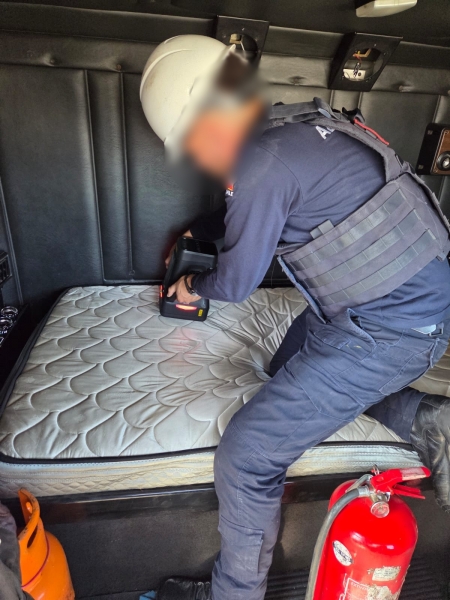
In this context, Customs deployed an average of 225 officers, 10 dogs, and 32 detection teams daily nationwide. During the inspections, 11,292 people and 5,882 vehicles, including cars, buses, and trucks, were inspected.
The operations led to several discoveries in different parts of the country. Among the most significant was the seizure made by Iquique Customs officials at the Quillagua checkpoint, where 18.86 kilograms of cocaine base were found hidden in a vehicle. In addition, 357 rounds of ammunition were discovered at the Dorotea checkpoint, while Punta Arenas Customs officials found 350 rounds and Osorno officials found 7 rounds at the Cardenal Samoré checkpoint.
Regarding smuggling, the Antofagasta Customs Office recorded operations that resulted in the arrest of nine people for cigarette smuggling. Meanwhile, the Valparaíso Customs Office recorded arrests related to violations of Law 20,000 (Drug Trafficking Law) and irregular immigration status, in addition to other procedures for traffic violations that were referred to the appropriate authorities.
Other results included the seizure of 362,700 vaporizers with essences in the Primary Zone of Iquique, goods whose customs value was estimated at more than US$9.3 million; 53 flares or pyrotechnic devices in the same premises, while the Metropolitan Customs seized 31 parts and pieces of weapons.
Customs’ participation is part of international cooperation efforts to strengthen border controls, improve the detection of illicit goods, and contribute to the fight against transnational organized crime.