Chilean Customs intelligence and data analysis help detect the transfer of 164 kilos of drugs to the Metropolitan Region
An intelligence operation, information analysis and criminal profiling, developed in a coordinated manner between the National Customs Service, the Investigations Police (PDI) and the Public Prosecutor’s Office, made it possible to detect the movements of an organization dedicated to drug trafficking and carry out an operation that culminated in the arrest of seven Colombian citizens —six men and one woman— in the vicinity of the Chucumata tollbooth, in the Tarapacá Region.
Customs’ contribution focused on its data analysis capabilities and constant exchange of information, tools that made it possible to identify movements of interest, promptly alert police agencies and activate the necessary coordination for the development of investigative actions.
The acting regional director of Customs, Narciso Donoso, highlighted the importance of collaboration between institutions and the capabilities that the Service brings to this type of investigation.
“This is yet another demonstration of how beneficial joint work is to the country, the region, and criminal investigations. Thanks to a collaborative effort between the Public Prosecutor’s Office, the Chilean Investigative Police, and our installed capacity as the National Customs Service, we have been able to deal a significant blow to smuggling, because in addition to the seizure of a large quantity of drugs, we also arrested eight people,” he emphasized.
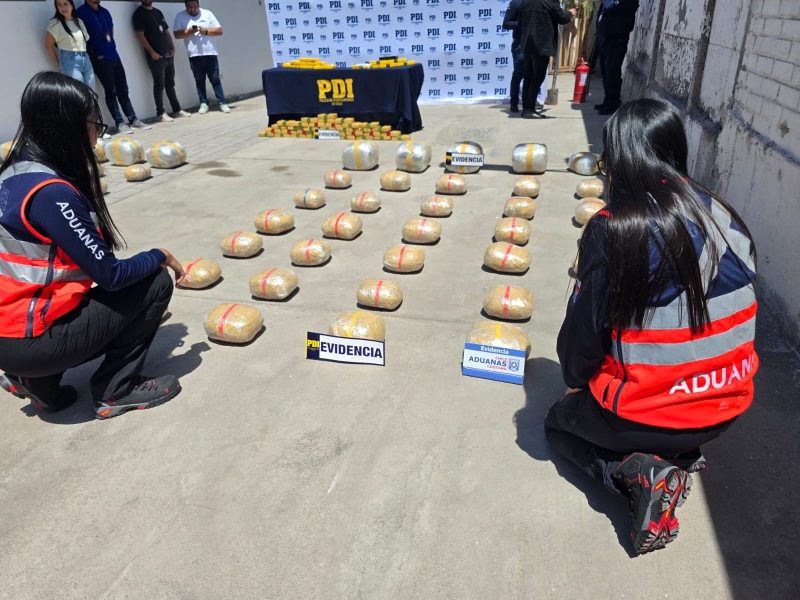
Based on this background, and under the direction of the Criminal Analysis System (SAC) of the Tarapacá Regional Prosecutor’s Office, detectives from the Iquique Anti-Narcotics Brigade carried out surveillance and monitoring work that allowed them to intercept two vehicles in which the defendants were transporting a total of 164 kilos 160 grams of drugs.
The shipment consisted of more than 14.5 kilos of cocaine hydrochloride, 34 kilos 440 grams of cocaine base and 115 kilos 180 grams of cannabis, substances that, according to the background of the investigation, had as their final destination the Metropolitan Region.
During the operation, authorities also seized the two vehicles used to transport the drugs and seven cell phones. Among those arrested was an individual with an outstanding arrest warrant for drug trafficking, issued by the Antofagasta Guarantee Court.
The regional prosecutor of Tarapacá, Virginia Aravena, explained that the investigation originated from background information obtained in previous cases, which allowed the movement of those involved to the municipality of Alto Hospicio to be established and the subsequent surveillance procedures to be carried out.
“This investigation stems from residual information obtained in previous cases, which allowed us to verify that these individuals were traveling to the municipality of Alto Hospicio, where they were monitored by Investigative Police personnel and subsequently found with this large quantity of drugs that they intended to smuggle out of the region. The detainees will be formally charged with the crime of illicit drug trafficking, and pretrial detention will be requested for all of them,” the regional prosecutor explained.
For his part, the head of the Tarapacá Police Region, Prefect Inspector José Contreras, highlighted the inter-institutional work that made it possible to carry out the operation and prevent the drugs from reaching their destinations.
“Today we were able to detect and arrest these individuals, and we can inform the public that we are removing a significant volume of drugs from circulation, drugs that were surely destined for the Metropolitan Region. We must highlight the joint work and coordination with the Public Prosecutor’s Office, inspectors from the National Customs Service, and our drug trafficking teams, which made these results possible,” he stated.
This procedure reflects Customs’ contribution to public safety strategies through information analysis, pattern detection, and data sharing with law enforcement agencies. These capabilities enable the timely identification of movements associated with illicit activities and facilitate the activation of police and investigative actions.

