Elevated Vigilance: Tethered Aerostats Bolster Border Security and C5ISR Strategy
By Eric Hoover. Director of Programs at TCOM LP
The Growing Role of Aerostats in Border Security
Border security and defending the homeland from unmanned systems and low-flying threats are enduring national security priorities. These missions are best served by a multi-layered approach, where aerostat systems play a vital role.
Modernized aerostat platforms combine automation and AI-driven command-and-control to reduce operating costs while increasing on-station time. They extend detection range beyond the radar horizon, provide valuable decision time, and act as force multipliers that complement ground, maritime, and space-based sensors.
This layered approach provides up to 30 days of persistent, 360-degree coverage and aligns with modernization efforts across DHS, CBP, and allied defense programs operating in contested environments worldwide.
Closing Persistent Coverage Gaps
Despite expanded use of fixed towers, ground sensors, and mobile platforms, coverage gaps remain, particularly in rugged, heavily vegetated, or remote areas.
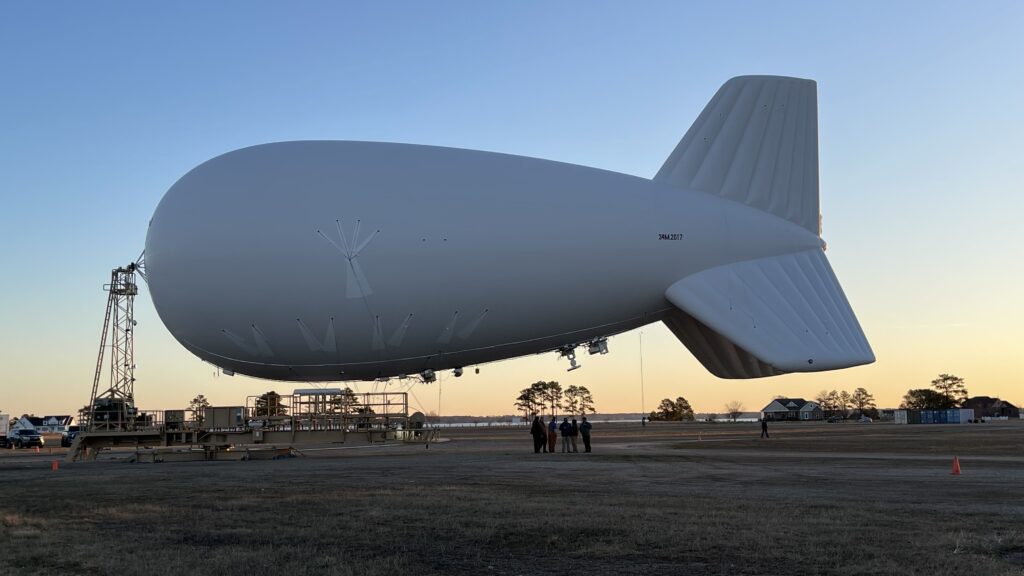
Operating at altitudes between 1,000 and 3,000 feet, tethered aerostats are uniquely suited to close these gaps. Their elevated vantage point provides 360-degree coverage across more than 40 miles, detecting threats long before they reach the border. Integrated into the Department of Homeland Security’s (DHS) C5ISR architecture, aerostats multiply the effectiveness of U.S. Customs and Border Protection (CBP) operations.
Aerostats as Proven Force Multipliers
Aerostats function as high-endurance airborne intelligence hubs. Equipped with EO/IR cameras, Ground Moving Target Indicator (GMTI) radar, and secure fiber-optic downlinks, they provide real-time intelligence to:
- CBP’s U.S. Border Patrol (USBP)
- Air and Marine Operations (AMO)
- DHS Joint Task Forces
- Supporting Department of Defense (DoD) commands
This integration enables rapid interdiction, coordinated multi-agency responses, and enhanced officer safety. Every second gained through early detection directly increases interdiction effectiveness.
Automation and Cost Efficiency
Automation is reshaping aerostat operations. Modern profiling tools optimize launch and recovery, while automated sensor cueing reduces operator workload. These advances improve availability and lower manpower needs.
One aerostat can cover the same area as multiple towers, reducing infrastructure investment and staffing requirements. For DHS and CBP, aerostats deliver superior surveillance reach while representing a fiscally sound approach.
Complementing Tower Coverage
Aerostats do not replace towers; they enhance them. Towers provide fixed monitoring, while aerostats add altitude, mobility, and flexibility. By eliminating blind spots caused by terrain, aerostats extend detection range and create a seamless layered network when paired with tower and ground-based assets.
Lessons from Global Contested Environments
Aerostats are not new to contested environments. The U.S. Army has deployed them for force protection in conflict zones, where persistent overwatch safeguarded forward operating bases and supported coalition partners. Internationally, aerostat radars have been integrated into missile-defense systems to provide critical early warning and tracking.
These operational lessons, drawn from complex theaters ranging from urban conflicts to maritime flashpoints, underscore the adaptability of aerostats. In an era where contested airspace defines global security challenges, ranging from great-power competition to regional instability, tethered aerostats have proven to be enablers of layered surveillance and defense.
Conclusion: Expanding Persistent Coverage
Modern aerostats are proven, persistent, and powerful. They close coverage gaps, amplify the reach of CBP and DHS field operators, deter illicit activity, and support broader C5ISR strategies.
By expanding deployment across vulnerable sectors at home while leveraging lessons from contested zones abroad, DHS, CBP, USBP, and AMO can establish a truly national aerial surveillance layer, ensuring operational control, enhancing interdiction, and strengthening layered homeland defense for the future.