
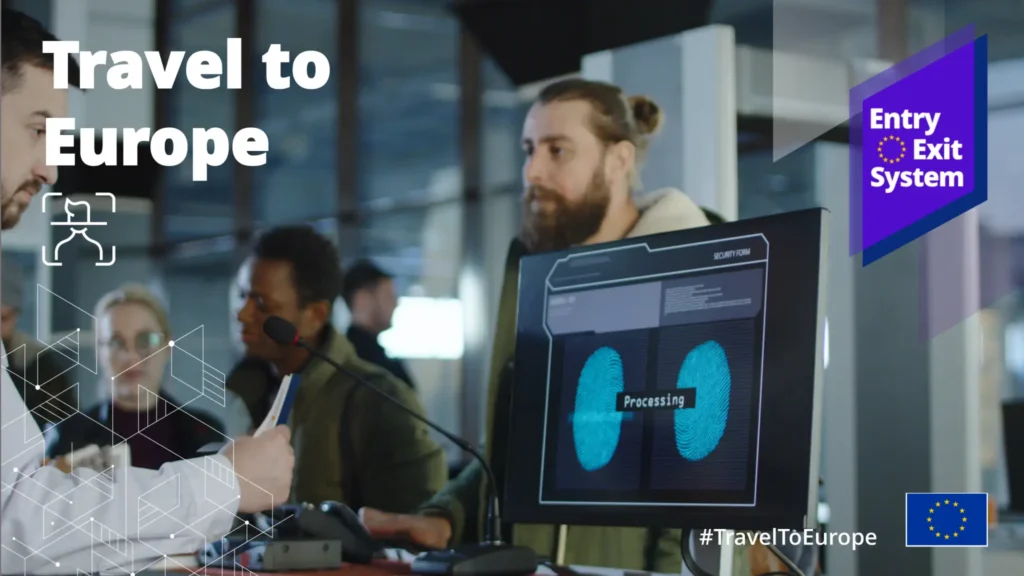
Europe’s borders go digital
The Entry/Exit System (EES) is the new IT system that digitally records the entry and exit of non-EU nationals travelling to 29 European countries* for short stays. The system has already recorded over 300 000 movements, with the number continuing to grow daily. The EES began implementation on 12 October 2025 and will be fully operational by 10 April 2026.
The EES is one of the world’s most modern border management systems, developed and managed by eu-LISA – the European Union Agency for the Operational Management of Large-Scale IT Systems in the Area of Freedom, Security and Justice. By collecting passport data, along with the dates and places of entry into and exit from European countries, as well as biometric data (facial images and fingerprints) and any refusals of entry, border checks will become faster and more efficient. The collection of biometric data will also improve the accuracy of identity verification. In addition, the new system will also help identify visa overstayers and prevent identity fraud.
As a result, the EES will support the identification of terrorists, criminals, suspects, and victims of crimes, by enabling authorities to cross-check information more effectively and trace individuals involved in criminal activities. It will therefore help law enforcement prevent, detect, and investigate serious crimes more efficiently, increasing security within the Schengen area, and strengthening the protection of European citizens.
Catherine De Bolle
Executive Director of Europol
By detecting and stopping criminals before they enter the EU, the EES helps protect everyone who calls Europe home. It strengthens our borders, but above all, it safeguards what defines us: the freedom to travel, work, and live in safety. Through its expertise and close international cooperation, Europol will play a key role in helping authorities detect threats, exchange information and make Europe safer.
Magnus Brunner
EU Commissioner for Internal Affairs
The EES is the digital backbone of our new approach to border management. We are equipping ourselves with the precise knowledge of who enters and leaves the EU, when, and where. That knowledge is powerful and marks a major milestone in strengthening our internal security. The new system will make it easier to identify irregular migrants and visa overstayers and to return those who have no right to stay in the EU.
Tillmann Keber
Executive Director of eu-LISA
The Entry/Exit System is a cornerstone of Europe’s new border management architecture — it is live, stable and performing well. With two major milestones already achieved this year, we have laid a solid foundation for the next steps of the Interoperability Roadmap. Through continued technical cooperation and close coordination with the Commission, Member States and EU agencies, eu-LISA remains fully committed to ensuring the system’s stability, scalability and security, delivering on our shared vision for a safer and more secure Europe.
Europol’s involvement
Europol will have access to the stored data for law enforcement purposes and will be able to perform searches in EES with biographical (name, date of birth, etc.) and biometric (fingerprints, facial images) data. These searches will be used to identify unknown suspects, perpetrators, or suspected victims of terrorist or other serious criminal offences, or to consult the travel history of known suspects, perpetrators, or suspected victims of such offences. Europol’s access to the EES is subject to strict conditions and procedures, based on case-by-case assessment and supervised by the European Data Protection Supervisor (EDPS).
The EES complies with high EU data protection standards to ensure travellers’ privacy and data security. Personal data will be processed exclusively for specific purposes, such as identify travellers who are using fake identities or passports. The purposes will be clearly communicated to travellers. All data will be processed in accordance with EU legislation, which ensures robust protection of individuals’ privacy.