Inside PNG’s Border Modernisation
Papua New Guinea’s adoption of the Digital Arrival Card marks a transformative moment in the nation’s border management journey. For decades, travellers entering PNG would complete a paper arrival card—an exercise that, while familiar, belonged to a different era of global mobility. What has replaced it is not simply a digital replica but a fundamentally new system that redefines how information is collected, analysed and shared, and how border agencies coordinate their roles.
The PNG Digital Arrival Card (PNGDAC) sits at the heart of a broader, multi-year modernisation strategy led by the Papua New Guinea Immigration & Citizenship Service Authority (ICSA). Chief Migration Officer Wellington Navasivu describes the PNGDAC as a pivotal step in repositioning PNG as a nation with modern, responsive and intelligence-driven border systems. His assessment is direct and confident: “People can think we digitised the arrival card because it’s convenient. Convenience is important—but this is much bigger. The PNGDAC is the foundation of a modern, intelligence-driven border. It transforms how we collect information, how we analyse it, and how we work with our partner agencies in real time.”
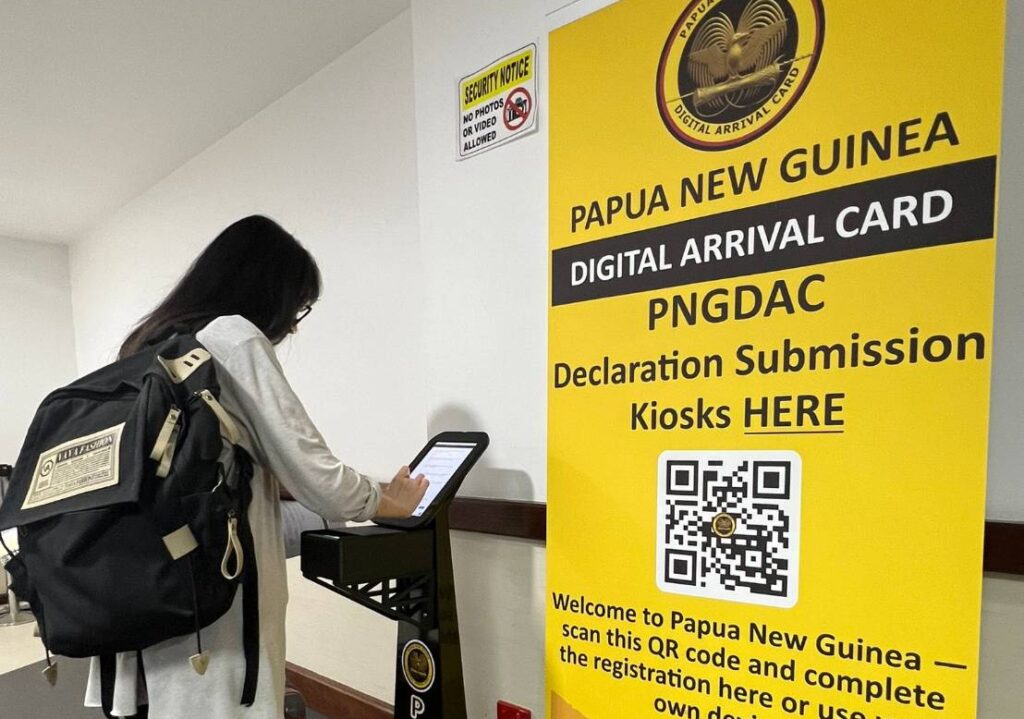
For travellers, the shift is immediately noticeable. The PNGDAC allows a passport to be scanned to populate key personal information fields automatically – before completion of important traveller information and declarations. This reduces typing, minimises errors, and speeds up submission. Travellers can complete the card online up to 72 hours before arrival, and CMO Navasivu strongly encourages advance submission to streamline clearance and reduce queues. However, for those who cannot or do not submit beforehand, kiosks positioned in the arrivals area provide a simple, guided alternative. These kiosks replicate the online experience and ensure no traveller is disadvantaged by limited digital access.
For PNG, a country with an extensive domestic and ever-growing international aviation network, the transition from paper to digital was not merely desirable—it was necessary. The old paper cards were prone to inaccuracies, handwriting errors, lost forms and delays as officers manually keyed details into separate databases. In contrast, the PNGDAC enables structured, validated information to be delivered in real time to authorised officers across several agencies. This includes immigration, customs and quarantine personnel who now use tablets and dedicated scanners throughout the entry process. Officers can review a traveller’s digital declaration while speaking with them directly, making follow-up questions clearer and more efficient and ensuring every agency has access to the same, accurate information at the same moment.
CMO Navasivu highlights this as a key operational shift. “We can now see people before they see us,” he notes. “But equally important is that, when the traveller is in front of us, every agency can see exactly what has been submitted and declared. That transparency improves accuracy and strengthens how we work together.”
A defining and unique characteristic of PNG’s Digital Arrival Card is its multi-agency design. In many countries, digital arrival cards fall primarily within the remit of a single agency. PNG, however, intentionally integrated immigration, customs and quarantine needs into one solution. A single submission now serves PNGICSA, the PNG Customs Service and the National Agriculture and Quarantine Inspection Authority (NAQIA). Each agency views the same dataset, enabling aligned and coordinated assessment and risk treatment.
CMO Navasivu describes the model succinctly: “One traveller, one declaration, three agencies—each keeping its own powers, but all seeing the same information. That is what makes the PNGDAC unique.” He emphasises that this integration strengthens rather than blurs institutional mandates. “Immigration decisions are made by immigration officers. Customs decisions are made by customs officers. NAQIA decisions are made by NAQIA officers. Integration does not require merging agencies—it means better information for everyone and with it, our existing cooperation and collaboration has only been enhanced.”
Another important element introduced with the PNGDAC is the ability for travellers to upload their vaccination records. This functionality provides PNG with an additional layer of public health readiness, enabling more efficient health screening, particularly during future public health emergencies. Digital vaccination information allows agencies to confirm health compliance while reducing the need to handle physical documents. In the CMO’s view, this is an essential safeguard: “The pandemic taught every country the value of health intelligence at the border. Being able to verify vaccination status digitally supports preparedness and protects our communities.”
A particularly distinctive feature of the PNGPNGDAC solution is the use of agency-specific tablets and scanners throughout the arrivals pathway, allowing immigration, customs and quarantine officers to conduct face-to-face reviews of a traveller’s declaration while standing directly with them. In most countries with digital arrival cards, declarations are submitted online and then processed primarily through back-office systems, with limited interaction between the traveller and the officer reviewing the data. PNG’s approach is different. The deployment of tablets at every control point means that each agency can immediately access the traveller’s full, validated declaration, cross-reference it with their own risk indicators, and ask targeted questions in real time. This strengthens the enforcement of each agency’s individual responsibilities—immigration can verify identity and travel intent; customs can review declared goods and duty requirements; NAQIA can examine biosecurity risks—all without duplication, repetition or confusion. The result is a system that preserves the distinct statutory mandates of each agency while enabling them to work from a single, authoritative source of data, right in front of the traveller.
This front-line, tablet-enabled model is also what gives PNG a true “whole-of-traveller” picture, a feature that sets it apart from many digital arrival systems globally. In several jurisdictions, integrated data exists behind the scenes but is not visible to individual officers in a unified, multi-agency format. PNG’s system, by contrast, makes that integration tangible at the point of interaction. Officers can see immigration, customs and quarantine-relevant details with a single swipe, reducing delays, preventing passengers from being redirected back and forth between counters, and enabling smoother, more coherent traveller movements through the airport.
It also strengthens collaboration among agencies: officers can confer instantly, escalate concerns to the appropriate partner, and coordinate interventions without disrupting the flow of travellers. This combination of real-time integration, face-to-face verification, agency autonomy, and seamless passenger facilitation gives the PNGPNGDAC a level of operational sophistication rarely found even in well-established digital border systems. As CMO Navasivu notes, the architecture “brings the best of digital innovation together with the best of professional judgement at the border,” ensuring that technology enhances—not replaces—the expertise of PNG’s front-line officers.
Behind the scenes, the PNGDAC is supported by the Immigration Operations Command Centre (IOCC), a modern facility equipped with trained officers who receive and analyse PNGDAC data as it is submitted. With the shift to digital, officers can conduct watchlist checks and risk assessments early, often before an aircraft departs for PNG. Because declarations are structured and digitally validated, inconsistencies and potential risks are easier to detect. “Advance profiling gives us time,” says CMO Navasivu. “Time allows us to focus our attention where it matters most.”
Front-line officers note that the digital system reduces administrative workload and allows them to focus more on meaningful interactions with travellers. One officer summarised the change simply: “Now we can concentrate on people, not paperwork.”
The transformation extends beyond security and compliance. The digital data generated through the PNGDAC is already proving valuable across government, supporting agencies such as the Tourism Promotion Authority with more timely and accurate insights. This data helps inform tourism planning, trend analysis and targeted promotional initiatives. It offers a clearer picture of visitor demographics, travel patterns and seasonal flows—information that was previously delayed or inaccessible under the paper-based system. CMO Navasivu describes this as an important secondary benefit: “Accurate arrival data has value far beyond border control. It supports tourism, public health, economic planning and a range of national priorities.”
The PNGDAC represents the first phase of PNG’s broader digital transition under the national eBorder Solution—a multi-year transformation programme designed to modernise and strengthen every stage of the country’s border management system. While the Digital Arrival Card is the most visible component to travellers, CMO Navasivu emphasises that it is only “the beginning of our full transition to a modern, technology-enabled border.”
Building on the momentum from the launch of the national eVisa platform and the introduction of the Sponsor Portal for employers, PNGICSA is advancing additional digital reforms that will fundamentally reshape how the country manages compliance and risk.
As CMO Navasivu explains, these initiatives are part of a deliberate, long-term strategy: “The eBorder Solution is about strengthening national security, making processing faster and more consistent, and aligning PNG with modern international standards. The PNGDAC is the first major step in that journey.”
This transformation also reflects PNG’s commitment to the regional security environment. PNGICSA continues to support border modernisation efforts across neighbouring Pacific Island countries, contributing expertise where it is needed and reinforcing the importance of interoperability and shared preparedness. CMO Navasivu notes that secure borders in the Pacific are a collective responsibility, and PNG’s investment in digital capability strengthens not only its own systems but the resilience of the broader region.
Delivering a digital border environment, however, requires careful implementation. PNGICSA has placed strong emphasis on training frontline officers, standard operating procedures, engaging airlines and supporting travellers during the transition. “Inclusion is part of security too,” CMO Navasivu reminds. “A modern border must be accessible to everyone, regardless of their digital confidence or background.”
As the Digital Arrival Card becomes fully embedded in PNG’s border operations, its value is increasingly evident. It strengthens national security by enabling earlier and more accurate risk assessments, improves the traveller experience through faster and more predictable processing, and enhances cooperation across immigration, customs and quarantine functions. The digital data it generates is already supporting other government agencies, including tourism, public health and economic planning. The PNGDAC signals that Papua New Guinea is not only modernising internal processes but also stepping confidently into a new era of international mobility, ready to meet global standards and future border challenges.
CMO Navasivu captures this ambition clearly: “Modern borders protect the country and serve the traveller at the same time. The PNGDAC lets us do both. It strengthens security, improves customer experience, and positions Papua New Guinea as a country that is ready for the future.” He adds, “This is the border PNG deserves—and we’re only just getting started.”
In concluding his reflections, CMO Navasivu also expressed appreciation for the partnership that supported the system’s development. He acknowledged SomapaIT for its expertise in the design and implementation of the PNGDAC. The solution was built upon SomapaIT’s proven Digital Arrival Card platform, originally designed and used in Thailand, but was extensively expanded and customised to meet Papua New Guinea’s operational, legislative and multi-agency integration requirements. CMO Navasivu emphasised that SomapaIT’s adaptability, technical depth and willingness to customise the platform to PNG’s unique border environment were instrumental in delivering a solution that strengthens security, enhances facilitation and reflects the country’s ambitions for a modern, digitally enabled border.
More Than a Digital Form: How Papua New Guinea Is Building an Intelligence-Driven Border”. , featuring insights from Mr Wellington Navasivu, Chief Migration Officer of the PNG Immigration & Citizenship Service Authority (PNGICSA).