
Securing the Seas around Small Island States
Intrinsic to global trade, geopolitical security and environmental stability, the maritime domain plays a critically important role in ensuring the uninterrupted use of the Global Commons and international connectivity. In this increasingly complex maritime environment, Maritime Domain Awareness (MDA) is essential to facilitate the delivery of good ocean governance, maritime border security and economic resilience.
Now more than ever, it is crucial that MDA systems are effective and efficient, enabling evidence-based attribution of criminal behaviour at sea and action to interrupt illegal activities. While all coastal nations’ security is strengthened from such maritime oversight, as highlighted by the UN Sustainable Development Goals, it is especially important that Small Island Developing States (SIDs), in particular, are suitably equipped to meet the challenges that they will face over the coming years. Essential to their own sovereignty, security and to realise the enormous potential in the Blue Economy, it is important that they have the resources at their disposal to be able to protect their maritime domain and know what is happening within it. However, the challenges that SIDs may face in achieving this are both considerable and frequently underestimated.
The Maritime Challenges for SIDs
Often presiding over large Exclusive Economic Zones (EEZ) which are sometimes hundreds or even thousands of times larger than their land mass, the maritime domains of small island states both teem with potential for economic development but also pose significant governance and security challenges.
Challenges that SIDs may face in their maritime domain are wide-ranging, encompassing illegal, unreported, and unregulated (IUU) fishing, transnational organised crime, pollution, trafficking, and climate-related maritime disasters. Moreover, if these challenges are not appropriately addressed and dealt with, they have the potential to threaten the economies, livelihoods, culture, and food security of these small island states.
Too often, these states lack the physical infrastructure, resources, and personnel to monitor their waters, resulting in sizeable maritime domains being left inadequately monitored and therefore protected in a timely and effective manner.
Moreover, these threats often stretch past national borders. Ineffective management of these, often transnational, challenges will invariably have transnational consequences, making it not only beneficial but, in fact, vital that these SIDs are supported to the greatest possible extent.
Addressing these challenges through new technology
These challenges can, however, be easily addressed through scalable, intelligent technology. Effective MDA, underpinned by maritime data sources, is a crucial first step that small island states can take to help prevent and address illegal and illicit actives in their maritime domains.
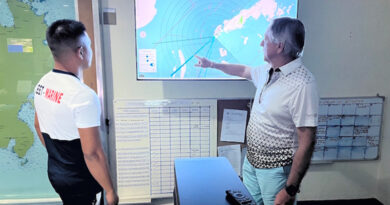
Technology platforms, such as web-based portals, can play an integral part in seeking to overcome the challenges that SIDs face. Organised into a user-friendly platform that filters big data from deployed sensors into clear, actionable insights, these tools enable maritime authorities to gain a deeper insight into and understanding of their maritime domains. While it is vital that SIDs are able to identify and address illegal activities, it is similarly important that they are able to identify legal activities and be able to distinguish between when to initiate early intervention and, conversely, when not to take action.
Through the integration of a diverse range of maritime data sources such as radar, AIS, and imagery, modern systems are able to generate a detailed real-time, maritime picture, providing a common multi-use service for multiple maritime users and elevating maritime authorities’ understanding of their domain and cooperation.
By deploying these technologies, maritime authorities in small island states become exceptionally well placed to respond to threats with a greater level of confidence and more efficiently, enabled to deploy precious and finite assets in a thoughtful and timely way, and with pinpoint accuracy. All of this contributes to ensuring that they are able to prioritise the security, safety and sovereignty of their territory and properly protect their citizens and assets.
Effective MDA technology is not only beneficial for the SIDs themselves but make a fundamentally important contribution to maintaining and enhancing international maritime partnerships.
Through the secure sharing of data across jurisdictions, MDA portals seamlessly support and strengthen international collaboration through shared alerts which can create coordinated responses to incidents ranging from IUU fishing to search and rescue operations, affirming the role that stronger Maritime Domain Awareness by SIDs is not only nationally beneficial, but transnationally, too.
Moreover, in order that no SIDs are left behind in this increasing digitisation of the management of maritime-related security and safety, it is important that MDA tools continue to be as cost-effective and scalable as possible as threats transform in size and type over time. Maximising MDA using commercial-off-the-shelf equipment and tracks (software)-as-a-service ensures that small island states are able to take advantage of dual-use capabilities that are both cost competitive and modular, benefit from scale and scope economies where practicable, and, in this way, it is possible to ensure that SIDs’ maritime security remains up to date, relevant and achievable, despite competing resources.
The scalability of this technology is equally fundamental to the future protection of SIDs. As threats and challenges are bound to change and develop, the technology deployed can similarly adhere to both these new challenges but also reflect emerging ambition and capability development. Strengthening the safety, security, and sustainability of small island states should be accessible and long-lasting, which many of the available technology ensures.
In addition to MDA technology, SIDs continue to benefit from their participation in organisations like the International Maritime Organisation (IMO) which provides global oversight and also regional mechanisms such as the Djibouti Code of Conduct (DCoC), Yaoundé Code of Conduct and other agreements designed to enhance regional cooperation and maritime security.
In the Caribbean, for example, the Regional Security System (RSS) is a multinational security alliance that upholds mutual assistance in security among member states, recognising that the security and safety of individual maritime domains are not only relevant to their respective nations but to contiguous states as well as those well beyond.
These interconnected and mutually reinforcing frameworks are an integral part of well-managed maritime governance and safety and, coupled with modern MDA technologies, SIDs have the opportunity to benefit individually and collectively from enhanced levels of rigour and protection.
Ensuring that the maritime domains of small island states are effectively monitored and protected goes beyond being a national imperative, but an intrinsic part of global interconnectivity and its future. Therefore, while it is a necessity that the sovereignty of small island states is upheld, this cannot happen without ongoing support. Through deploying MDA technology, and further bolstering international information sharing, SIDs are significantly better equipped to address and mitigate the threats that they are face.
While small island states may face threats and challenges that are unique to them, their consequences can have global repercussions. Significant and continuous improvements in the ability to manage MDA will undoubtedly be beneficial to SIDs as well as to their regional and international partners, promoting the confidence and economic vitality that naturally flows from the ability to enhance transnational security, safety, and sustainability.
Change is afoot. Rarely has there been a time when the ability to understand and secure a maritime domain was so readily available. But that is now within the grasp of any small island state keen to enhance its own security, safety and resilience.
By Sirius Insight