The Centauri TriAD counter-UAS ready for deployment
The TriAD counter-drone system from Centauri Technologies has shown itself to be ready for deployment in a border protection role.
Centauri’s TriAD system fuses radar, RF (radio frequency) and electro-optical sensors with AI decision-support to detect, prioritise and defeat hostile drones in real time with multiple hard-kill effectors.
“Recent integrated, multi-layered C-UAS (counter-unmanned aerial system) trials has proven and validated the TriAD system’s capabilities,” said Xander Louw, chief product officer.
The system was shown publicly for the first time in February this year at the IDEX2025 international defence exhibition in Abu Dhabi, United Arab Emirates.
Whilst the vehicle-mounted configuration has demonstrated end-to-end detection, tracking, identification and defeat of small unmanned aerial systems from one interoperable system, its architecture is highly modular and flexible.
“It can be integrated on armoured vehicles – even light vehicles, on naval vessels or as a static installation in border areas and around airfields and military bases,” Louw stated.
In the single vehicle-integrated solution it can provide effective, layered protection for border patrols, convoys on the move, bases and high-value assets.
The tests combined proven sensors with Centauri’s remotely operated weapon stations (ROWS) and a unified Command and Control stack.
The Centauri TriAD was developed as a sensor agnostic platform to integrate various detection and tracking sensors. However, the remotely operated weapon stations (ROWS) are Centauri proprietary systems. They comprise the CRx-7 (7.62 mm LMG), CRx-30 (30×113 mm cannon) and CRx-40 (six-shot 40 mm grenade launcher) remote weapon stations, providing a graduated kinetic response.
The trials proved that tracking from the 360° radars matched with RF detections and EO/IR imagery from the optical sensors significantly reduces false positives, thus enabling speedy identification and fast confident engagement decisions.
Importantly, the TriAD’s decision-support algorithm proved that it ranks multiple simultaneous contacts, which produces engagement orderings aligned with the operator judgement.
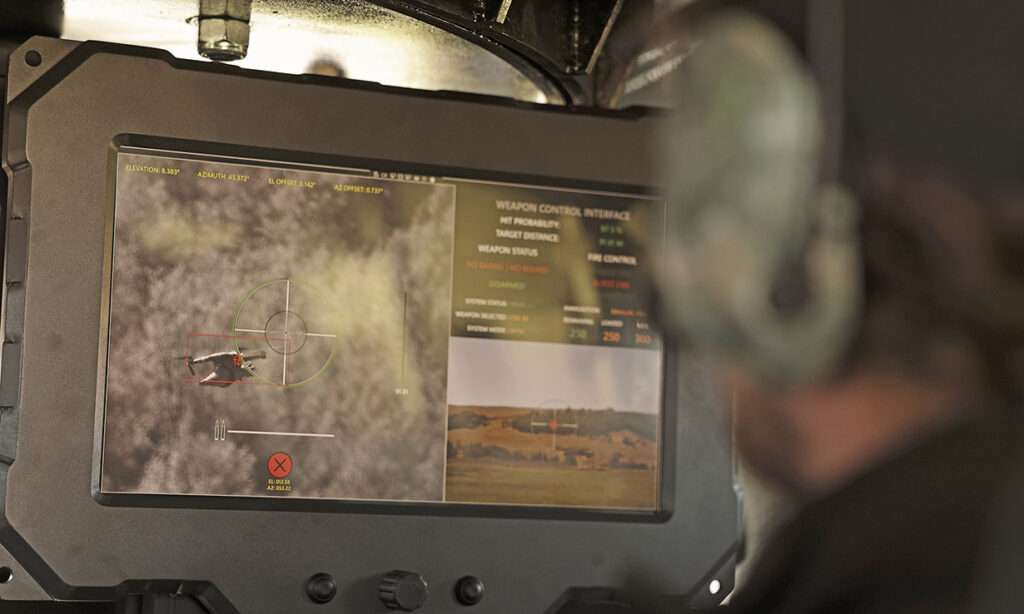
“This in effect means the Command and Control (C2) system fuses radar, RF and optical tracks into a single tactical picture, which feeds AI-based classifiers,” Louw explained. “In this manner, threats are prioritised and the operator gets recommendations for an optimal effector, i.e. which weapon to use.”
In the event of a low-threat reconnaissance drone, the operator could use RF jamming or fire the CRx-7 7.62 mm light machine gun (LMG). For higher-risk or hardened drone platforms, the 30 mm CRx-30 cannon (long-range) or CRx-40 (close-in protection) grenade launcher could be fired using airburst munitions.
The TriAD features human-machine interface (HMI) that allows the operator fast handover between the sensor feeds and provides single-click selection of recommended effectors (weapons) or manual override.
“The TriAD can be configured with different sensor/effector mixes, depending on customer needs,” he stressed. “Some might prefer a sensor-heavy detection grid with soft-kill options, while others would opt for a hard-kill vehicle-mounted solution for contested environments.”
Centauri’s trials reflect an industry-wide shift toward layered, networked counter-UAS approaches that combine sensors, soft-kill and hard-kill options under unified decision systems. Customers benefit from Centauri’s single vendor-delivered integration that shortens time-to-deploy compared with assembling disparate subsystems.
“What remains for us to do, is acceptance testing and qualification,” he said. “Centauri will soon expand the trial envelope to include EW (electronic warfare) resilience tests, GNSS (Global Navigation Satellite System) denial scenarios and longer-range integration with vehicle convoys,” Louw concluded.