
The Challenges Behind the EU Entry/Exit System Rollout
The European Union’s Entry/Exit System (EES) represents one of the most significant changes to European border management in decades. Designed to replace manual passport stamping with a digital process based on biometric identification, the system aims to strengthen security, improve the monitoring of visitor stays, and provide border authorities with more accurate information about the movement of travellers into and out of the Schengen Area.
While the strategic objectives of the programme have received broad support from policymakers and security professionals, the implementation of the system has proved considerably more challenging than originally anticipated. The rollout has highlighted the complexities associated with introducing large-scale technology across multiple countries, agencies and transport networks, while also exposing practical operational issues at airports, ports and land borders.
An Ambitious Programme
The EES is intended to record the entry and exit of non-EU nationals travelling for short stays within the Schengen Area. Instead of receiving a passport stamp, travellers have key personal information recorded electronically, including biometric data such as fingerprints and facial images.
The programme is designed to improve the identification of overstayers, strengthen law-enforcement cooperation, and support border authorities in identifying potential security threats. However, achieving these objectives requires the integration of national border systems, biometric technologies and central European databases on an unprecedented scale.
The technical complexity alone would make the programme challenging. Combined with the operational realities of busy international border crossings, implementation has become a major undertaking.
Repeated Delays and Readiness Concerns
One of the most visible challenges has been the number of delays experienced before full deployment.
Several planned launch dates were postponed as authorities assessed the readiness of infrastructure, software platforms and national border control systems. Concerns were raised about whether all participating countries could achieve operational readiness at the same time and whether the technology had been sufficiently tested under real-world conditions.
The decision to move towards a phased implementation reflected recognition that a simultaneous launch across the entire Schengen Area carried significant operational risks. Allowing countries additional time to complete preparations reduced the likelihood of widespread disruption but also highlighted the complexity of coordinating a multinational technology programme.
Technology Integration Challenges
The implementation of EES requires numerous systems to work together seamlessly.
National border control systems must communicate with central databases, biometric devices must accurately capture traveller information, and border officers must be able to access records quickly and reliably. Even minor technical problems can have significant operational consequences when thousands of passengers are being processed every hour.
Authorities have reported challenges relating to software integration, data synchronisation, biometric enrolment procedures and equipment reliability. While such issues are common during the introduction of new technologies, their impact is amplified in border environments where delays can quickly affect large numbers of travellers.
The need to maintain high levels of security while processing passengers efficiently adds further complexity to system design and operation.
Airport Infrastructure Constraints
Many airports were designed around traditional document inspection processes rather than biometric registration.
The introduction of EES has required the installation of fingerprint scanners, facial image capture systems, self-service kiosks and additional processing areas. In some locations, available space has been limited, making it difficult to redesign passenger flows without affecting existing operations.
Airport operators have had to balance security requirements, passenger experience and physical infrastructure limitations. In older terminals, the challenge has been particularly acute, as expansion opportunities are often restricted.
As a result, some airports have invested significantly in facility modifications, while others continue to adapt their layouts to accommodate the new requirements.
Queue Management and Passenger Delays
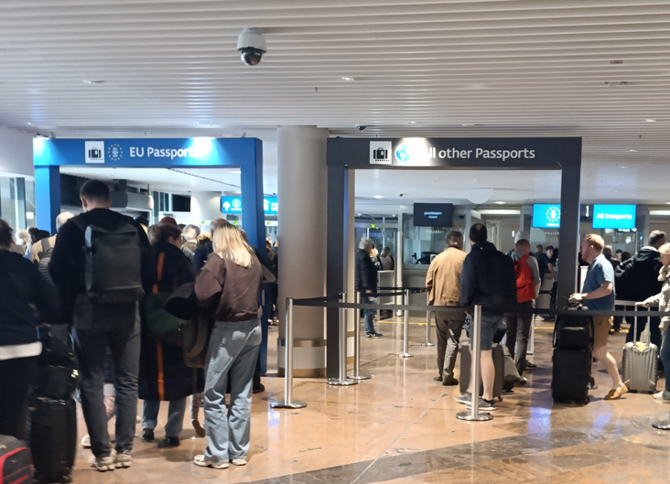
Perhaps the most widely discussed consequence of the rollout has been the impact on passenger processing times.
The first registration of a traveller under EES requires biometric enrolment, which inevitably takes longer than a traditional passport stamp. While the additional time required for each individual traveller may appear relatively small, the cumulative effect can be substantial at busy border crossings.
Even modest increases in processing time can lead to significant queues when large volumes of passengers arrive simultaneously. This is particularly relevant at major international airports handling long-haul arrivals and large numbers of non-EU visitors.
Industry bodies representing airports and airlines have repeatedly warned that the introduction of biometric processing could increase waiting times, particularly during peak travel periods. Summer holiday traffic, major sporting events and periods of concentrated flight arrivals all place additional pressure on border control resources.
The challenge is not limited to airports. Ferry terminals and international rail hubs face similar concerns, particularly where large numbers of passengers must be processed within short timeframes.
Staffing and Training Requirements
The successful operation of EES depends not only on technology but also on people.
Border officers must understand new procedures, assist travellers unfamiliar with the process, resolve technical issues and manage exceptions when biometric enrolment is unsuccessful.
Comprehensive training programmes have therefore been essential.
At the same time, many border authorities continue to face recruitment and staffing challenges. Increased processing requirements can place additional pressure on existing resources, particularly during busy travel periods.
Where staffing levels do not match passenger demand, queues can grow rapidly regardless of the capability of the underlying technology.
Traveller Awareness and Public Communication
A further challenge has been ensuring that travellers understand the new procedures before arriving at the border.
Many passengers remain unfamiliar with biometric enrolment requirements and the reasons behind them. Border authorities and transport operators have therefore invested in public information campaigns designed to explain the system and reduce confusion.
Clear communication is particularly important during the early stages of implementation, when travellers may be encountering the system for the first time. Effective preparation can reduce processing times and improve the overall passenger experience.
Balancing Security and Efficiency
The difficulties experienced during the rollout highlight a broader challenge facing modern border management: balancing security requirements with the need for efficient passenger movement.
EES offers substantial benefits from a security perspective. Electronic records provide greater accuracy than manual passport stamping, improve visibility of traveller movements and support more effective immigration control.
However, these benefits must be achieved without creating unacceptable levels of disruption for legitimate travellers. Finding the right balance between security, operational efficiency and passenger convenience remains one of the central challenges facing border authorities across Europe.
In conclusion, the rollout of the EU Entry/Exit System demonstrates both the opportunities and challenges associated with large-scale digital transformation programmes. While the long-term objectives of improved security, better border management and enhanced traveller data remain widely supported, implementation has been complicated by technical integration challenges, infrastructure constraints, staffing requirements and concerns about passenger processing times.
Airport queues and border delays have become the most visible symptoms of these challenges, but they are only part of a much broader transformation effort involving governments, border agencies, transport operators and technology providers across Europe.
As experience grows and systems mature, many of the early operational difficulties are likely to be reduced. Nevertheless, the EES rollout provides a valuable lesson in the realities of implementing complex security technologies within high-volume operational environments where efficiency, security and public confidence must all be maintained simultaneously.