

Advances in Drone and Counter-Drone Technology for Border Security
Ukraine’s struggle for existence against Putin’s aggressive expansionism has proved to be a catalyst for the rapid adoption and development of a relatively new and upcoming technology, as wars so often are. In World War I it was the aircraft and in Ukraine it is unmanned aircraft, and the impact on the world of the latter will prove just as profound.
Many of us have been talking about the potential threats posed by drone technology for years but it is in the battle for Ukraine that the technology has truly come of age.
There are now killing zones between the lines where it is almost impossible for humans and armoured vehicles to move in daylight without coming under attack.
As the drones themselves continue to develop in both control, payload and endurance, the tactics in their optimal use is being developed and perfected. And of course these lessons will filter through rapidly to both good and bad actors around the world.
As drone technology continues to evolve, the need for effective counter-drone measures becomes increasingly critical, especially in the realm of border security. In recent months, significant advancements have been made in detection systems, interception techniques, and the integration of these technologies into existing security frameworks.
This article explores these developments.
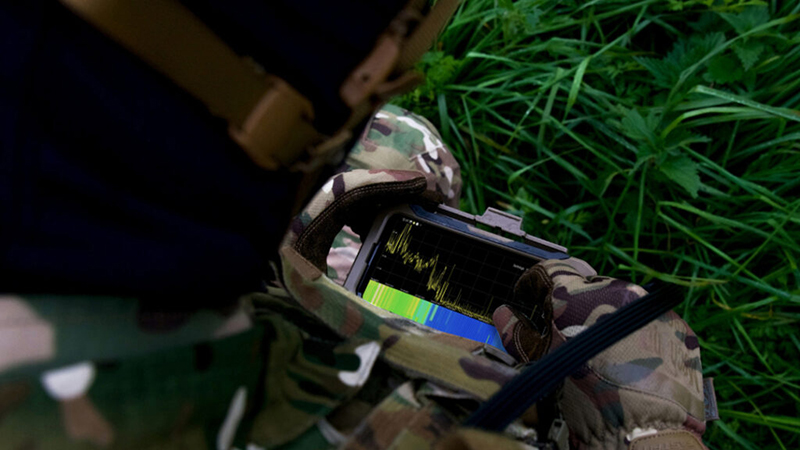
The effectiveness of any counter-drone operation begins with the ability to accurately detect and identify potential threats. Recent advancements in detection systems have made remarkable strides in this area. Traditional radar systems, once primarily used for aerial surveillance, have been enhanced to improve their detection capabilities, particularly for smaller drones that were previously challenging to identify. Modern radar technologies now utilise advanced algorithms and multi-frequency operations, enabling them to distinguish between various aerial objects with greater precision. The integration of optical and infrared sensors further strengthens detection capabilities, allowing for a multi-layered approach to monitoring airspace. This combination empowers operators to visualise drone activity under a range of conditions, including low-light or adverse weather scenarios.
In addition to improvements in radar technology, the application of artificial intelligence (AI) and machine learning has transformed the analysis of drone threats. These technologies can process vast amounts of data from multiple sensors in real-time, facilitating quicker and more accurate identification of potential threats. By learning from previous drone behaviours and flight patterns, AI systems enhance their ability to differentiate between authorised drones and those that may pose a risk. This improvement significantly boosts situational awareness for border security personnel, enabling them to respond more effectively to potential incursions.
Once a drone threat is detected, the next crucial step is to neutralise it effectively. Recent advancements in countermeasures and interception techniques have significantly improved the ability to respond to drone incursions. One of the most notable developments in counter-drone technology is the enhancement of radio frequency (RF) jamming systems. These systems are designed to identify and disrupt the communication between a drone and its operator, effectively taking control away from the user. Recent advancements have led to the creation of more sophisticated jammers that can target specific frequencies while minimising interference with other communications. This precision makes them ideal for border security applications, where maintaining the integrity of the local civilian RF environment is necessary.
Moreover, innovations in kinetic interceptors have gained traction within the counter-drone arena. Kinetic interceptors, such as nets or projectiles designed to capture or disable drones, are being refined to enhance their accuracy and effectiveness. The development of directed energy weapons, including high-power lasers, represents a new frontier in counter-drone capabilities. These systems can disable drones from a distance, reducing the risk of collateral damage and providing operators with precise control over the engagement process. As these technologies continue to evolve, they offer new solutions for effectively managing drone threats in border security contexts.
The successful integration of counter-drone technologies into existing surveillance frameworks is crucial for maximising their effectiveness. Recent advancements have focused on creating comprehensive command and control platforms that facilitate the seamless integration of counter-drone systems with existing security infrastructure. This unified approach enables border security personnel to monitor drone activity alongside other security measures, facilitating a coordinated and timely response to potential threats. Enhanced communication between various systems ensures that operators can act swiftly and efficiently when a drone is detected, thereby reducing the likelihood of unauthorised incursions.
Cloud computing has also played a vital role in improving the ability to store and share data across different agencies and organisations involved in border security. This capability allows for real-time updates and information sharing, enhancing situational awareness and enabling a more effective response to drone-related incidents. By creating a centralised data repository, agencies can analyse trends and patterns in drone activity, leading to informed decision-making and proactive measures. The ability to share information across jurisdictions fosters collaboration and strengthens overall border security efforts.
In conclusion, significant advancements in counter-drone technology for border security have emerged over the past six months, particularly in detection systems, interception techniques, and the integration of these technologies into existing surveillance frameworks. As these technologies continue to evolve, they will play a crucial role in safeguarding borders against the increasing threat posed by unauthorised drones. By leveraging improved detection capabilities, effective countermeasures, and integrated systems, border security forces can enhance their operational readiness, ensuring greater safety and security in the airspace surrounding national borders.
The Future Role of Autonomous Flight and AI Integration in Drone Technology
Autonomous flight and AI integration in drones represent a significant leap in technology, enabling these devices to operate independently and perform complex tasks without direct human intervention. At the heart of this advancement is a combination of sophisticated navigation systems and cutting-edge sensors that work together to enhance a drone’s capabilities.
Navigation in most drones currently relies on line-of-sight, on-board camera control using RF signal or facilitated through Global Positioning System (GPS) and Global Navigation Satellite System (GNSS) technologies, which provide real-time location data. This allows drones to accurately determine their position and navigate to their intended destination whether that is in the control of an operator or autonomously to a known GPS location.
However, as authorities deploy more RF and GPS jamming and interdiction systems, Inertial Measurement Units (IMUs)or Inertial Navigation Systems (INS) are likely to become more frequently used by bad actors try to circumvent border security systems.
IMUs or INS combine accelerometers and gyroscopes to track the drone’s orientation, speed, and acceleration. This information is essential for maintaining stability allowing them to navigate to any given point without the need for RF control or GPS.
Lidar (Light Detection and Ranging) sensors emit laser beams to measure distances, and height, creating detailed 3D maps and AI can compare these with pre-programmed maps and satellite images. Cameras, paired with computer vision algorithms, allow drones to recognise landmarks, contours, roads, rivers and other objects, track their own movements and make informed decisions based on visual input. Moreover, AI frameworks and tools such as TensorFlow and PyTorch are instrumental in developing AI models that can be deployed on drones for tasks like object detection and classification. OpenCV, an open-source computer vision library, is commonly used to develop image processing algorithms essential for visual recognition and obstacle detection. This technology effectively enables drones to ‘map read’ their way to a given point, again avoiding the need for RF or GPS signal.
There is, however, a caveat: I am not currently aware of any small to medium-sized drones successfully using this technology (please let me know if you are). But the technology is already out there, so it will happen.
To enhance safety and operational efficiency, drones utilise real-time processing capabilities. Onboard processors analyse data from various sensors, enabling drones to detect obstacles such as trees and buildings and make split-second decisions to alter their flight paths. Machine learning algorithms further empower drones by enabling them to learn from their environment. Over time, this learning process improves their obstacle avoidance skills, making them more adept at navigating complex terrains.
The integration of AI significantly enhances autonomous flight. AI algorithms can determine the most efficient routes based on environmental data, mission objectives, and potential hazards, including known and new security installations such as towers but also recognise new objects such as vehicles. This allows drones to adapt their flight plans dynamically in response to changing conditions, without requiring human intervention.
In conclusion, the combination of autonomous flight capabilities and AI integration is transforming the landscape of drone technology, enabling them to perform a wide range of tasks with remarkable efficiency and accuracy. As these technologies continue to evolve, they open up new possibilities across various sectors while also presenting challenges that necessitate careful consideration and regulation.
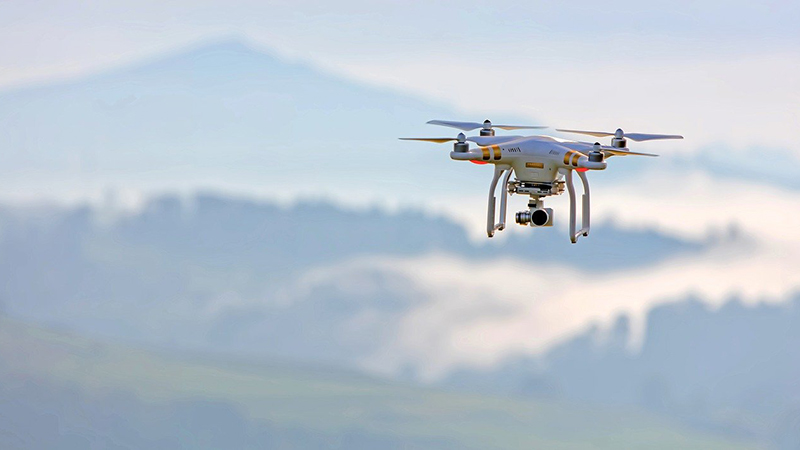

Here’s a summary of counter-drone (UAV/UAS) developments related to border security over the recent months:
Allen Vanguard has launched the SECURIS a rapidly deployable C-UAS trailer, featuring a multi-faceted detection suite combining the advanced RF detection capabilities of SKYPERION from Metis which is used globally by NATO allies in various integrated systems, and the unique radar target acquisition capabilities of Blighter’s A400 series, which is also operationally proven globally and the advanced optical recognition system Vision Flex from Openworks for its long-range imagers, dynamic slew-to-cue capability, and twin-AI modules for detection, tracking and identification.
Blighter Surveillance Systems signed a contract to supply its advanced drone detection radar systems to various border security agencies in Europe. The contract focuses on enhancing the capabilities of these agencies to monitor and secure border areas against unauthorized drone activities, specifically targeting illegal crossings and smuggling operations.
Fortem Technologies secured contracts with various U.S. military branches and border security agencies to implement its drone detection and interception systems. This initiative aims to bolster security at border areas and critical infrastructure by providing real-time monitoring and automated responses to drone threats.
Cambridge Pixel announced a contract to integrate its radar processing technology with existing border surveillance systems. This integration aims to enhance the detection of UAVs and improve situational awareness for border control agencies, allowing for quicker response times to potential drone threats.
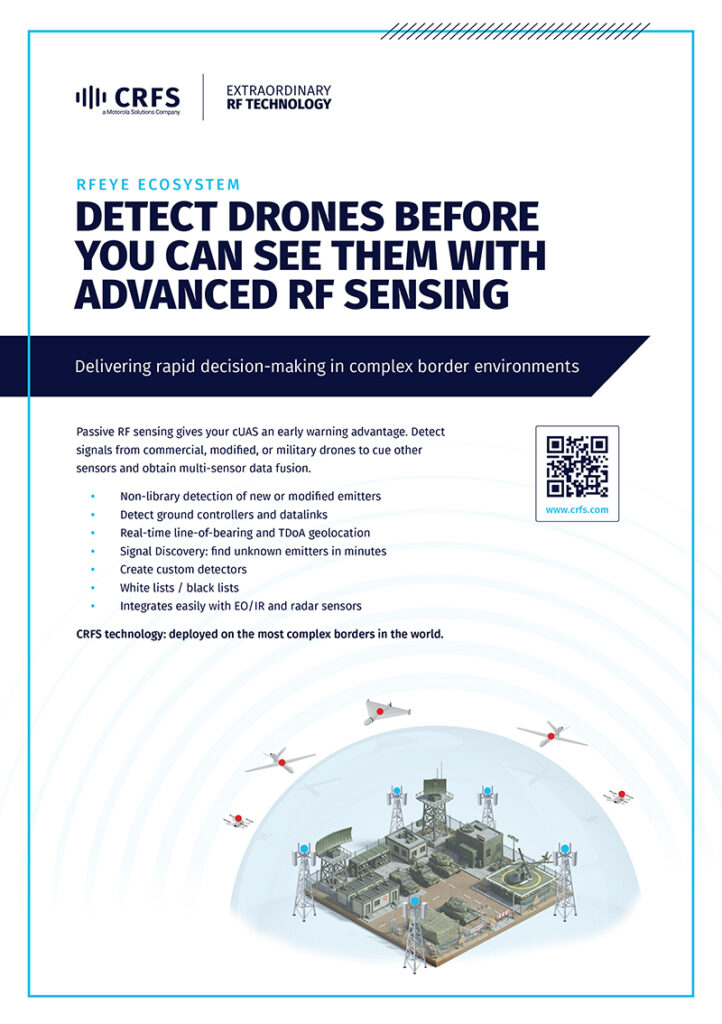
CRFS have recently introduced a new software feature for their RFeye Site, spectrum monitoring and geolocation system, it’s called Signal Discovery. Detecting RF emissions from drones generally requires either a library-based system, anomaly detection expertise, or advanced analysis to characterize unknown waveforms. This is a problem for c-UAS operators for whom threats are usually unknown and detection is time-critical. Signal Discovery for their RFeye Site solves this problem by automatically discovering every signal in the chosen frequency range and presenting this data in an intuitive heatmap. Operators can then filter out what they are not interested in and focus on signals of interest, reducing search time. Once an unknown drone signal is identified, operators can carry out a real-time geolocation and coordinate a wider c-UAS response. Signal Discovery turns a complex spectrum into clear intelligence to secure borders.
Back in August, D-Fend Solutions launched the EnforceAir PLUS, a cyber-driven, multilayer, AI-enhanced counter-drone system comprised of foundational RF-cyber detection and takeover technology, now integrated with auto-calibrated radar detection and optional jamming mitigation.
DroneShield entered into a contract with the Australian Border Force to deploy its counter-drone technology at key border entry points. The system will enhance the agency’s ability to detect and neutralize unauthorized drones, particularly in areas prone to trafficking and illegal entries.
Echodyne unveiled its new EchoShield Rapid Deployment Kit (RDK) which expanded its radar portfolio to include an all-inclusive radar kit with four Echoshield radars and supporting components that allow the radars to be fully operational quickly in any domain. Designed for operational readiness in under an hour, the EchoShield RDK delivers durable, hemispherical coverage up to 25 km, enabling rapid detection, tracking, and classification of drones across diverse missions and environments.
MyDefence announced the launch of its WideBand eXtended Frequency (XF) Antenna, a powerful new tool enabling dismounted border security personnel, and police forces to detect remotely controlled drones across the wide spectrum – a capability increasingly critical in homeland security missions.
Thales secured a contract with French Customs to enhance border security with its drone detection and countermeasures systems. This initiative aims to improve the agency’s ability to monitor drone activities and protect against potential threats related to illegal trafficking across the French borders.
To read this article and more: Download the Nov/Dec 2025 issue