
AI At The Border
How a Decade of European Research is Reshaping Border Management, Customs Controls and Traveller Processing
Standfirst
Artificial intelligence is rapidly becoming the intelligence layer connecting sensors, surveillance systems, customs controls, biometrics and operational decision-making. A major Joint Research Centre review of 75 EU-funded projects reveals how Europe is building the foundations for a new generation of border management capabilities. This article examines the technologies, projects and operational lessons shaping the future border ecosystem.
The Rise of the Intelligent Border
Over the past decade artificial intelligence has evolved from a promising research topic into one of the most strategically important technologies in border management. The European Commission Joint Research Centre analysed 75 EU-funded projects launched between 2015 and 2024 and identified around €376 million of investment directed towards AI applications in border management and customs control. The significance of this investment lies not only in the amount spent but in the breadth of operational challenges addressed. Researchers are applying AI to maritime awareness, customs inspections, risk analysis, traveller identification, document security and autonomous systems. The projects collectively demonstrate a major shift in thinking. Border agencies are no longer seeking isolated technology upgrades. They are building digital ecosystems capable of transforming information into operational advantage. Border authorities face increasing traveller numbers, expanding maritime zones, evolving organised crime networks and growing expectations from political leaders and the public. Artificial intelligence is increasingly viewed as a force multiplier capable of helping existing personnel analyse more information and make decisions more quickly. The result is the emergence of the intelligent border, where data, analytics and operational systems are linked together in ways that were impossible only a few years ago.
Over the past decade artificial intelligence has evolved from a promising research topic into one of the most strategically important technologies in border management. The European Commission Joint Research Centre analysed 75 EU-funded projects launched between 2015 and 2024 and identified around €376 million of investment directed towards AI applications in border management and customs control. The significance of this investment lies not only in the amount spent but in the breadth of operational challenges addressed. Researchers are applying AI to maritime awareness, customs inspections, risk analysis, traveller identification, document security and autonomous systems. The projects collectively demonstrate a major shift in thinking. Border agencies are no longer seeking isolated technology upgrades. They are building digital ecosystems capable of transforming information into operational advantage. Border authorities face increasing traveller numbers, expanding maritime zones, evolving organised crime networks and growing expectations from political leaders and the public. Artificial intelligence is increasingly viewed as a force multiplier capable of helping existing personnel analyse more information and make decisions more quickly. The result is the emergence of the intelligent border, where data, analytics and operational systems are linked together in ways that were impossible only a few years ago. Over the past decade artificial intelligence has evolved from a promising research topic into one of the most strategically important technologies in border management.
The European Commission Joint Research Centre analysed 75 EU-funded projects launched between 2015 and 2024 and identified around €376 million of investment directed towards AI applications in border management and customs control. The significance of this investment lies not only in the amount spent but in the breadth of operational challenges addressed. Researchers are applying AI to maritime awareness, customs inspections, risk analysis, traveller identification, document security and autonomous systems. The projects collectively demonstrate a major shift in thinking. Border agencies are no longer seeking isolated technology upgrades. They are building digital ecosystems capable of transforming information into operational advantage. Border authorities face increasing traveller numbers, expanding maritime zones, evolving organised crime networks and growing expectations from political leaders and the public. Artificial intelligence is increasingly viewed as a force multiplier capable of helping existing personnel analyse more information and make decisions more quickly. The result is the emergence of the intelligent border, where data, analytics and operational systems are linked together in ways that were impossible only a few years ago.
Maritime Surveillance Comes of Age
Maritime surveillance represents the largest concentration of projects identified in the study. Programmes such as MARISA, CAMELOT, COMPASS2020, EFFECTOR, EURMARS and I-SEAMORE illustrate how European researchers are attempting to build persistent situational awareness across vast maritime areas. The common challenge is managing enormous quantities of information generated by vessels, satellites, coastal radars, drones and other surveillance assets. MARISA focused on data fusion, combining conventional surveillance sources with open-source intelligence and social media information to support decision making. CAMELOT explored advanced command-and-control environments capable of coordinating manned and unmanned platforms. COMPASS2020 demonstrated how offshore patrol vessels can operate as launch and control centres for autonomous aerial and underwater systems. EFFECTOR concentrated on interoperability and the integration of maritime information sources through advanced data-lake architectures. More recent projects including EURMARS and I-SEAMORE seek to integrate high-altitude platforms, UxVs, satellite imagery and AI-powered analytics into unified operational environments. Together these programmes highlight the growing importance of collaboration, interoperability and common operational pictures. Future maritime surveillance will likely depend on collecting information from multiple sources and sharing it rapidly across organisations.
Maritime surveillance represents the largest concentration of projects identified in the study. Programmes such as MARISA, CAMELOT, COMPASS2020, EFFECTOR, EURMARS and I-SEAMORE illustrate how European researchers are attempting to build persistent situational awareness across vast maritime areas. The common challenge is managing enormous quantities of information generated by vessels, satellites, coastal radars, drones and other surveillance assets. MARISA focused on data fusion, combining conventional surveillance sources with open-source intelligence and social media information to support decision making. CAMELOT explored advanced command-and-control environments capable of coordinating manned and unmanned platforms. COMPASS2020 demonstrated how offshore patrol vessels can operate as launch and control centres for autonomous aerial and underwater systems. EFFECTOR concentrated on interoperability and the integration of maritime information sources through advanced data-lake architectures. More recent projects including EURMARS and I-SEAMORE seek to integrate high-altitude platforms, UxVs, satellite imagery and AI-powered analytics into unified operational environments. Together these programmes highlight the growing importance of collaboration, interoperability and common operational pictures. Future maritime surveillance will likely depend on collecting information from multiple sources and sharing it rapidly across organisations. Maritime surveillance represents the largest concentration of projects identified in the study. Programmes such as MARISA, CAMELOT, COMPASS2020, EFFECTOR, EURMARS and I-SEAMORE illustrate how European researchers are attempting to build persistent situational awareness across vast maritime areas. The common challenge is managing enormous quantities of information generated by vessels, satellites, coastal radars, drones and other surveillance assets. MARISA focused on data fusion, combining conventional surveillance sources with open-source intelligence and social media information to support decision making. CAMELOT explored advanced command-and-control environments capable of coordinating manned and unmanned platforms. COMPASS2020 demonstrated how offshore patrol vessels can operate as launch and control centres for autonomous aerial and underwater systems. EFFECTOR concentrated on interoperability and the integration of maritime information sources through advanced data-lake architectures. More recent projects including EURMARS and I-SEAMORE seek to integrate high-altitude platforms, UxVs, satellite imagery and AI-powered analytics into unified operational environments. Together these programmes highlight the growing importance of collaboration, interoperability and common operational pictures. Future maritime surveillance will likely depend on collecting information from multiple sources and sharing it rapidly across organisations.
The New Era of Data Fusion and Anomaly Detection
If a single theme runs through the report it is data fusion. Border organisations already possess a wealth of information. The challenge is connecting disparate systems and extracting meaningful intelligence. Projects such as EFFECTOR, PROMENADE and AI-ARC aim to address precisely this problem. PROMENADE developed a suite of AI-based services capable of vessel detection, behaviour analysis, route classification and anomaly identification using radar data, AIS transmissions, imagery and open-source intelligence. AI-ARC created a Virtual Control Room designed to reduce information overload by presenting operators with customised operational pictures. Research associated with the project demonstrated how artificial intelligence can identify dark vessels, unusual movement patterns and suspicious maritime activities. EFFECTOR showed how interoperability between systems can support faster operational responses by bringing together information from multiple authorities. Anomaly detection is becoming one of the most valuable use cases for artificial intelligence because it allows human operators to focus on genuinely suspicious behaviour rather than routine activity. Future systems are expected not just to report what is happening but also assess risk levels and identify activities that differ from established patterns. This transition from observation towards predictive awareness could fundamentally alter maritime security operations. If a single theme runs through the report it is data fusion. Border organisations already possess a wealth of information. The challenge is connecting disparate systems and extracting meaningful intelligence. Projects such as EFFECTOR, PROMENADE and AI-ARC aim to address precisely this problem. PROMENADE developed a suite of AI-based services capable of vessel detection, behaviour analysis, route classification and anomaly identification using radar data, AIS transmissions, imagery and open-source intelligence.
AI-ARC created a Virtual Control Room designed to reduce information overload by presenting operators with customised operational pictures. Research associated with the project demonstrated how artificial intelligence can identify dark vessels, unusual movement patterns and suspicious maritime activities. EFFECTOR showed how interoperability between systems can support faster operational responses by bringing together information from multiple authorities. Anomaly detection is becoming one of the most valuable use cases for artificial intelligence because it allows human operators to focus on genuinely suspicious behaviour rather than routine activity. Future systems are expected not just to report what is happening but also assess risk levels and identify activities that differ from established patterns. This transition from observation towards predictive awareness could fundamentally alter maritime security operations.
If a single theme runs through the report it is data fusion. Border organisations already possess a wealth of information. The challenge is connecting disparate systems and extracting meaningful intelligence. Projects such as EFFECTOR, PROMENADE and AI-ARC aim to address precisely this problem. PROMENADE developed a suite of AI-based services capable of vessel detection, behaviour analysis, route classification and anomaly identification using radar data, AIS transmissions, imagery and open-source intelligence. AI-ARC created a Virtual Control Room designed to reduce information overload by presenting operators with customised operational pictures. Research associated with the project demonstrated how artificial intelligence can identify dark vessels, unusual movement patterns and suspicious maritime activities. EFFECTOR showed how interoperability between systems can support faster operational responses by bringing together information from multiple authorities. Anomaly detection is becoming one of the most valuable use cases for artificial intelligence because it allows human operators to focus on genuinely suspicious behaviour rather than routine activity. Future systems are expected not just to report what is happening but also assess risk levels and identify activities that differ from established patterns. This transition from observation towards predictive awareness could fundamentally alter maritime security operations.
Smart Customs and Cargo Security
The report provides equally compelling insights into the transformation of customs inspections. Growing international trade volumes make comprehensive physical inspection impossible. Customs agencies therefore increasingly rely upon risk-based approaches supported by advanced technology. Projects including C-BORD, ENTRANCE, SilentBorder and MULTISCAN 3D examined how machine learning and advanced sensing technologies could improve cargo screening operations. Rather than opening containers unnecessarily, future customs systems may automatically identify anomalies within scan images and prioritise shipments presenting elevated risk. Similar research is underway for baggage and parcel inspection through initiatives such as PARSEC and BAG-INTEL. The objective is to improve detection rates for narcotics, weapons, contraband and other illicit goods without disrupting legitimate commerce. Artificial intelligence is particularly valuable when analysing large image datasets that would otherwise require extensive manual review. The customs sector therefore offers one of the clearest examples of AI delivering measurable operational benefits. Faster inspections, improved detection accuracy and more efficient allocation of resources are recurring themes across the projects reviewed. As trade flows continue to expand, intelligent inspection systems are likely to become increasingly important. The report provides equally compelling insights into the transformation of customs inspections. Growing international trade volumes make comprehensive physical inspection impossible. Customs agencies therefore increasingly rely upon risk-based approaches supported by advanced technology. Projects including C-BORD, ENTRANCE, SilentBorder and MULTISCAN 3D examined how machine learning and advanced sensing technologies could improve cargo screening operations. Rather than opening containers unnecessarily, future customs systems may automatically identify anomalies within scan images and prioritise shipments presenting elevated risk. Similar research is underway for baggage and parcel inspection through initiatives such as PARSEC and BAG-INTEL. The objective is to improve detection rates for narcotics, weapons, contraband and other illicit goods without disrupting legitimate commerce.
Artificial intelligence is particularly valuable when analysing large image datasets that would otherwise require extensive manual review. The customs sector therefore offers one of the clearest examples of AI delivering measurable operational benefits. Faster inspections, improved detection accuracy and more efficient allocation of resources are recurring themes across the projects reviewed. As trade flows continue to expand, intelligent inspection systems are likely to become increasingly important. The report provides equally compelling insights into the transformation of customs inspections. Growing international trade volumes make comprehensive physical inspection impossible. Customs agencies therefore increasingly rely upon risk-based approaches supported by advanced technology. Projects including C-BORD, ENTRANCE, SilentBorder and MULTISCAN 3D examined how machine learning and advanced sensing technologies could improve cargo screening operations. Rather than opening containers unnecessarily, future customs systems may automatically identify anomalies within scan images and prioritise shipments presenting elevated risk. Similar research is underway for baggage and parcel inspection through initiatives such as PARSEC and BAG-INTEL. The objective is to improve detection rates for narcotics, weapons, contraband and other illicit goods without disrupting legitimate commerce. Artificial intelligence is particularly valuable when analysing large image datasets that would otherwise require extensive manual review. The customs sector therefore offers one of the clearest examples of AI delivering measurable operational benefits. Faster inspections, improved detection accuracy and more efficient allocation of resources are recurring themes across the projects reviewed. As trade flows continue to expand, intelligent inspection systems are likely to become increasingly important.
Biometrics, Digital Identity and Trusted Travel
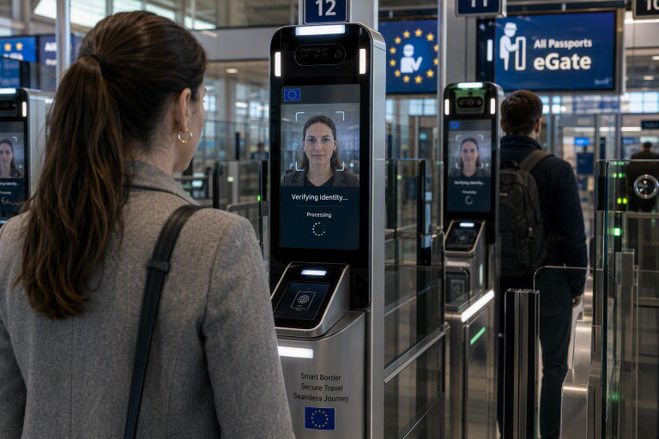
Identity verification remains one of the most visible applications of artificial intelligence in border environments. Multiple projects examined biometric technologies, document security and digital identity management. Programmes such as iBorderCtrl, PROTECT, SMILE, eBORDER and ODYSSEUS explored how contactless biometrics and multimodal identity verification might support faster traveller processing. Researchers investigated facial recognition, iris recognition, liveness detection and behavioural indicators while simultaneously examining privacy implications. Document security projects such as Smart-Trust and SafeTravellers focused on detecting fraudulent travel documents and identity manipulation techniques. The long-term objective is a frictionless travel experience in which legitimate travellers move rapidly through border controls while security risks are identified more effectively. Digital identity ecosystems are expected to play a significant role in future border management strategies. Trusted traveller concepts, mobile identities and advanced authentication methods all feature prominently within the research portfolio. Despite technological progress, deployment remains closely linked to regulatory compliance and public acceptance. The challenge facing agencies is therefore not simply technical implementation but creating systems capable of maintaining trust while delivering operational benefits. Identity verification remains one of the most visible applications of artificial intelligence in border environments. Multiple projects examined biometric technologies, document security and digital identity management. Programmes such as iBorderCtrl, PROTECT, SMILE, eBORDER and ODYSSEUS explored how contactless biometrics and multimodal identity verification might support faster traveller processing.
Researchers investigated facial recognition, iris recognition, liveness detection and behavioural indicators while simultaneously examining privacy implications. Document security projects such as Smart-Trust and SafeTravellers focused on detecting fraudulent travel documents and identity manipulation techniques. The long-term objective is a frictionless travel experience in which legitimate travellers move rapidly through border controls while security risks are identified more effectively. Digital identity ecosystems are expected to play a significant role in future border management strategies. Trusted traveller concepts, mobile identities and advanced authentication methods all feature prominently within the research portfolio. Despite technological progress, deployment remains closely linked to regulatory compliance and public acceptance. The challenge facing agencies is therefore not simply technical implementation but creating systems capable of maintaining trust while delivering operational benefits. Identity verification remains one of the most visible applications of artificial intelligence in border environments. Multiple projects examined biometric technologies, document security and digital identity management. Programmes such as iBorderCtrl, PROTECT, SMILE, eBORDER and ODYSSEUS explored how contactless biometrics and multimodal identity verification might support faster traveller processing. Researchers investigated facial recognition, iris recognition, liveness detection and behavioural indicators while simultaneously examining privacy implications. Document security projects such as Smart-Trust and SafeTravellers focused on detecting fraudulent travel documents and identity manipulation techniques. The long-term objective is a frictionless travel experience in which legitimate travellers move rapidly through border controls while security risks are identified more effectively. Digital identity ecosystems are expected to play a significant role in future border management strategies. Trusted traveller concepts, mobile identities and advanced authentication methods all feature prominently within the research portfolio. Despite technological progress, deployment remains closely linked to regulatory compliance and public acceptance. The challenge facing agencies is therefore not simply technical implementation but creating systems capable of maintaining trust while delivering operational benefits.
Autonomous Systems and Infrastructure Protection
Another significant trend identified by the report is the rapid growth of autonomous systems. Drones, unmanned surface vessels and underwater vehicles appear across multiple projects. Researchers increasingly view autonomous assets as force multipliers capable of extending surveillance coverage while reducing operational costs. Projects such as COMPASS2020, SEAGUARD and I-SEAMORE explored how multiple autonomous systems can operate together within integrated surveillance frameworks. At the same time projects including UnderSec, SMAUG and VIGIMARE investigated protection of underwater infrastructure such as pipelines, cables and port facilities. Recent geopolitical developments have increased concern regarding maritime infrastructure resilience. Artificial intelligence is being used to analyse sonar data, detect underwater anomalies and support threat identification. Machine learning models can recognise subtle indicators that may signal interference, sabotage or suspicious activity. Combined with autonomous platforms, these capabilities offer authorities new methods for monitoring high-value assets. The result is a growing convergence between border security, maritime resilience and critical infrastructure protection. Another significant trend identified by the report is the rapid growth of autonomous systems. Drones, unmanned surface vessels and underwater vehicles appear across multiple projects. Researchers increasingly view autonomous assets as force multipliers capable of extending surveillance coverage while reducing operational costs. Projects such as COMPASS2020, SEAGUARD and I-SEAMORE explored how multiple autonomous systems can operate together within integrated surveillance frameworks. At the same time projects including UnderSec, SMAUG and VIGIMARE investigated protection of underwater infrastructure such as pipelines, cables and port facilities. Recent geopolitical developments have increased concern regarding maritime infrastructure resilience. Artificial intelligence is being used to analyse sonar data, detect underwater anomalies and support threat identification. Machine learning models can recognise subtle indicators that may signal interference, sabotage or suspicious activity. Combined with autonomous platforms, these capabilities offer authorities new methods for monitoring high-value assets. The result is a growing convergence between border security, maritime resilience and critical infrastructure protection.
Ethics, Trust and the AI Act
One of the defining characteristics of the European approach to artificial intelligence is the attention devoted to ethics and governance. Unlike many technology programmes that focus exclusively on performance, several projects examined transparency, explainability, privacy and societal acceptance. Researchers recognise that public trust will influence adoption every bit as much as technical capability. The report repeatedly references concerns relating to surveillance, bias, accountability and database interoperability. These issues become particularly important in applications involving biometrics and law enforcement. The introduction of the EU AI Act further reinforces the importance of governance. High-risk AI applications face requirements relating to transparency, human oversight and data governance. Border agencies therefore operate within one of the most demanding regulatory environments for artificial intelligence anywhere in the world. Yet many researchers view this not as a barrier but as an opportunity to create systems that are robust, explainable and trusted. Ensuring that AI augments rather than replaces human judgement remains a central principle throughout the projects examined. One of the defining characteristics of the European approach to artificial intelligence is the attention devoted to ethics and governance. Unlike many technology programmes that focus exclusively on performance, several projects examined transparency, explainability, privacy and societal acceptance. Researchers recognise that public trust will influence adoption every bit as much as technical capability. The report repeatedly references concerns relating to surveillance, bias, accountability and database interoperability. These issues become particularly important in applications involving biometrics and law enforcement.
The introduction of the EU AI Act further reinforces the importance of governance. High-risk AI applications face requirements relating to transparency, human oversight and data governance. Border agencies therefore operate within one of the most demanding regulatory environments for artificial intelligence anywhere in the world. Yet many researchers view this not as a barrier but as an opportunity to create systems that are robust, explainable and trusted. Ensuring that AI augments rather than replaces human judgement remains a central principle throughout the projects examined.
What Border Security Leaders Should Watch Next
The overall lesson from a decade of research is that artificial intelligence is becoming the connective tissue linking modern border ecosystems. Future operational environments are likely to be characterised by human-machine teaming, data sharing, autonomous systems and integrated command centres. Agencies that successfully connect sensors, databases and operators will gain the greatest operational advantage. Maritime awareness, customs targeting, traveller processing and critical infrastructure protection increasingly rely on the same underlying capabilities: data fusion, analytics and decision support. The projects reviewed by the Joint Research Centre do not suggest a future in which machines replace border officers. Instead they point towards environments in which personnel are supported by intelligent systems capable of processing much larger quantities of information. The border of the future may therefore be less about physical infrastructure and more about the intelligence layer sitting behind it. Europe’s research portfolio demonstrates that this future is already beginning to take shape. The overall lesson from a decade of research is that artificial intelligence is becoming the connective tissue linking modern border ecosystems. Future operational environments are likely to be characterised by human-machine teaming, data sharing, autonomous systems and integrated command centres. Agencies that successfully connect sensors, databases and operators will gain the greatest operational advantage. Maritime awareness, customs targeting, traveller processing and critical infrastructure protection increasingly rely on the same underlying capabilities: data fusion, analytics and decision support. The projects reviewed by the Joint Research Centre do not suggest a future in which machines replace border officers.
Instead they point towards environments in which personnel are supported by intelligent systems capable of processing much larger quantities of information. The border of the future may therefore be less about physical infrastructure and more about the intelligence layer sitting behind it. Europe’s research portfolio demonstrates that this future is already beginning to take shape. The overall lesson from a decade of research is that artificial intelligence is becoming the connective tissue linking modern border ecosystems. Future operational environments are likely to be characterised by human-machine teaming, data sharing, autonomous systems and integrated command centres. Agencies that successfully connect sensors, databases and operators will gain the greatest operational advantage. Maritime awareness, customs targeting, traveller processing and critical infrastructure protection increasingly rely on the same underlying capabilities: data fusion, analytics and decision support. The projects reviewed by the Joint Research Centre do not suggest a future in which machines replace border officers. Instead they point towards environments in which personnel are supported by intelligent systems capable of processing much larger quantities of information. The border of the future may therefore be less about physical infrastructure and more about the intelligence layer sitting behind it. Europe’s research portfolio demonstrates that this future is already beginning to take shape.
This article is a summary of a report by ANDERSON, D., BELCINEANU, A.-I. and TZVETKOVA, M., – AI for Border Management and Customs Controls – Anthology of EU-funded projects, 2015-2024
https://data.europa.eu/doi/10.2760/1286492, JRC143223