
Smart Borders Albania 2030: From Travel Intelligence to Intelligent Border Management
Albania’s journey towards a Smart Borders ecosystem is not simply a technology project. It represents a fundamental shift in the way travel data, intelligence, automation and privacy protection are brought together to manage modern mobility. With the adoption of Law No. 38/2025 on the Processing of Travel Information and Law No. 124/2024 on Personal Data Protection, Albania has established the legal and operational foundations for a new generation of intelligence-led border management systems aligned with European and international standards.
Across Europe and beyond, border authorities face a common challenge. International travel continues to expand while criminal networks, traffickers and terrorist organisations increasingly exploit the same transportation systems used by legitimate travellers. Traditional border controls alone are no longer sufficient. Modern agencies require advance visibility of passenger movements, rapid risk assessment capabilities and the ability to identify high-risk subjects before arrival, while ensuring the smooth movement of legitimate travellers.
This reality has driven the emergence of Smart Borders programmes around the world. Supported by ICAO, IATA, the United Nations and the OSCE, these initiatives seek to combine passenger data, biometrics, automation and intelligence into a single risk-based border management framework.
For Albania, the transition begins with the evolution of the former Passenger Information Unit into a broader Travel Intelligence Sector. Rather than focusing solely on collecting passenger data, the SIU is intended to become a centre for strategic analysis, targeting, intelligence production and operational cooperation. The scope of travel intelligence now extends beyond aviation to include information from maritime and land transport operators, creating a much richer understanding of travel patterns and mobility trends.
The transformation reflects a move from passive information collection to proactive intelligence generation. Advance Passenger Information, interactive API and Passenger Name Record data provide the raw material from which analysts can identify trafficking indicators, uncover organised crime networks, detect suspicious travel behaviour and support counter-terrorism operations.
A future Albanian Smart Borders platform is likely to rest on several interconnected capabilities. Central to the concept is a Passenger Data Single Window, recommended by ICAO Annex 9, allowing carriers to submit traveller information through a single technical gateway. Such an approach simplifies connectivity, improves data quality and creates a common operational picture across government agencies.
Advanced analytics will play an equally important role. Artificial intelligence and predictive modelling systems can assist analysts by identifying hidden relationships within large travel datasets, highlighting anomalies and providing early warning indicators. Human oversight, however, remains essential to ensure accountability, transparency and compliance with privacy obligations.
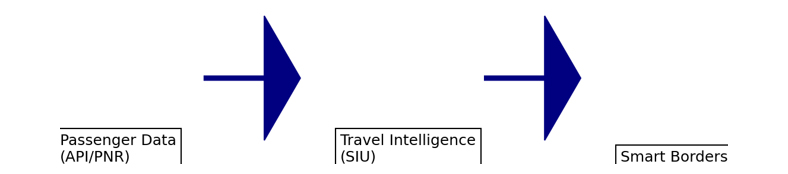
At the border itself, automation will increasingly shape the traveller experience. e-Gates, self-service kiosks, biometric verification and contactless processing technologies have the potential to reduce waiting times while enabling officers to concentrate resources on higher-risk individuals. Figure 1 illustrates the conceptual relationship between passenger data, travel intelligence and Smart Borders operations.
The success of any Smart Borders programme depends not only on technology but on interoperability. Effective information sharing between border authorities, law enforcement agencies, customs organisations, intelligence services and international partners is essential if travel intelligence is to generate operational value. The SIU is positioned to become the central hub for lawful travel information exchange and coordinated risk assessment.
Albania’s ambitious vision also places privacy at the centre of system design. Security and privacy should not be viewed as competing objectives. Instead, successful Smart Borders architectures embed data protection principles from the outset through transparency, lawful processing, purpose limitation, auditability and robust governance mechanisms. Encryption, access controls, retention policies and independent oversight are all critical components of public trust.
The alignment of Albanian legislation with GDPR and the EU Law Enforcement Directive demonstrates a commitment to ensuring that travel intelligence capabilities develop within a clear legal framework. This approach reflects a broader European trend towards privacy-by-design governance where technological innovation is accompanied by strong safeguards for individual rights.
International standards provide an equally important foundation. ICAO guidance on API, PNR and Passenger Data Single Windows, IATA’s One ID vision, United Nations counter-terrorism initiatives and OSCE border management principles all contribute to a common framework that supports secure mobility. By aligning with these standards, Albania strengthens both national security and its ability to cooperate with regional and international partners.
Figure 2 demonstrates the potential operational impact of Smart Border technologies. While actual performance depends on infrastructure, procedures and traffic volumes, the comparison illustrates how automation can significantly reduce processing times while maintaining security oversight.
Conclusion
Albania is positioning itself to become one of Southeast Europe’s most progressive Smart Borders environments. By integrating API, PNR, travel intelligence, analytics and privacy-by-design governance into a coherent operational architecture, the country is laying the groundwork for intelligence-led border management that strengthens security while facilitating legitimate travel. The establishment of the Travel Intelligence Sector provides a platform for future interoperability, advanced analytics and automated border control capabilities. If successfully implemented, the model could serve as a regional example of how technology, intelligence and democratic safeguards can be brought together to support secure and efficient mobility.
By PhD Chief Commissioner Artur Beu, Travel Intelligence Sector (SIU), Albanian State Police