Chilean Customs in Iquique seizes more than 36 kilos of drugs during the National Holidays using various detection methods
Six operations resulted in the seizure of marijuana, cocaine, crack cocaine, and ecstasy during checks carried out in Colchane, El Loa, Quillagua, and at Diego Aracena Airport. The operations involved detections using X-rays, particle analyzers, and an alert issued by the General Directorate of Civil Aeronautics (DGAC).
During the end of the National Holidays, customs inspectors from Iquique carried out six procedures that allowed them to detect and seize 36.5 kilos of different drugs, in controls carried out at control points and the Diego Aracena International Airport.
The operations resulted in the seizure of 31.2 kilograms of marijuana, 2.7 kilograms of cocaine base, 2.1 kilograms of cocaine hydrochloride, and 595 grams of MDA, using various concealment strategies, including false bottoms in luggage, substances strapped to the body, and hidden compartments inside buses. In addition, three abandoned drugs were found, and one seizure stemmed from an airport alert.
“During the National Holidays, we reinforced our inspection capabilities and our response to alerts related to the increased passenger traffic at the country’s authorized border crossings, particularly those under the jurisdiction of the Iquique Customs Office. At three of these crossings, those transporting the drugs realized the impending inspections and abandoned their cargo on the spot. These results demonstrate the importance of combining the work of our inspectors with the various technological tools available and maintaining constant coordination with other agencies,” stated the Regional Director of Customs, Ricardo Aceituno.
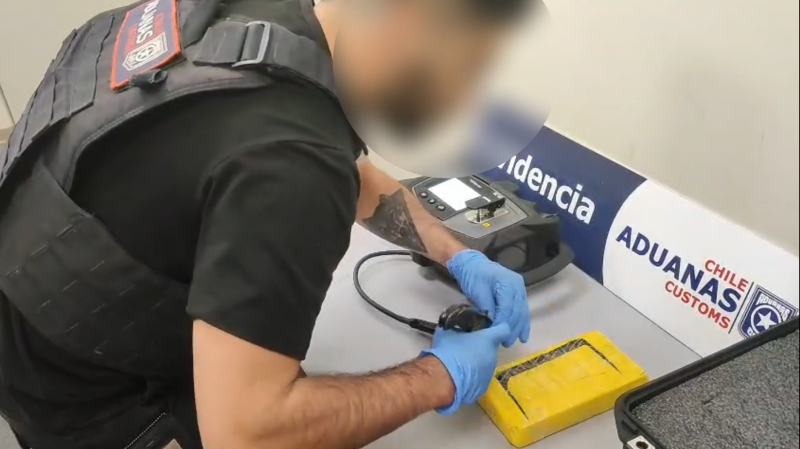
One of the procedures took place at the Colchane Border Crossing, where an X-ray scan detected an anomaly in a backpack belonging to a Bolivian traveler. Further inspection revealed that the luggage had a false bottom concealing a package containing 993 grams of cocaine base. A field test was conducted using a particle analyzer.
In the El Loa area, officers from the Drug Enforcement Unit discovered an abandoned black sack containing 30 packages with 31.2 kilograms of marijuana. Since the owner could not be identified, the procedure was recorded as a finding. The substance was subjected to a field test which yielded a positive result for marijuana.
Another discovery occurred in Quillagua, where a bus inspection revealed a bag inside the bathroom trash can. Inside were 60 capsules containing 655 grams of cocaine base.
Also in Quillagua, officials discovered 798 pills of various colors and shapes hidden inside the trash can of a bus bathroom. Three of them were tested using Trunarc technology, which yielded a positive result for MDMA or ecstasy, with a total weight of 595 grams.
In another case, at the Quillagua checkpoint, a Bolivian passenger was selected after an X-ray machine detected an anomalous image in her backpack. The search revealed a false bottom containing 1,020 grams of cocaine hydrochloride. The passenger also admitted to carrying three additional packages strapped to her body, containing 1,035 grams of cocaine base. In total, this operation resulted in the seizure of 2,055 kilograms of drugs.
Finally, at Diego Aracena International Airport, in a joint operation, officers from the Drug Enforcement Unit inspected a Chilean passenger traveling from Iquique to the Biobío Region, following an alert issued by the Directorate General of Civil Aviation. The inspection revealed a package concealed in the passenger’s abdominal area, attached to the waistband of his trousers, containing 1,048 grams of cocaine hydrochloride. The substance was subjected to a field test using a particle analyzer.
The background information, the detainees, and the seized substances were handed over to the appropriate authorities, in accordance with established procedures.
“This activity is part of the Security and Control Program in the Fight Against Transnational Organized Crime, at Customs jurisdiction points in the Tarapacá Region during these National Holidays, prioritizing the selection of high-risk targets among passengers, vehicles and cargo units, demonstrating the importance of combining this work by our officials and the permanent coordination with other agencies, to ultimately mitigate the risk of drug trafficking and smuggling that attempt to continue towards the central zone of the country,” emphasized the Regional Director of Customs, Ricardo Aceituno.