Developments in Hand-held Search and Detection Technology for Border Agencies
In an increasingly complex global landscape, border agencies face numerous challenges related to security threats, illegal immigration, human trafficking, drug trafficking and contraband smuggling. Alongside this, the rise in transnational crime and the ever present threat of terrorism necessitates the adoption of advanced technologies that can enhance the effectiveness of border security operations.
Spot checks and stop-and-search operations have long been the essential tools for customs and border agencies, serving as a proactive measure against illegal activities such as smuggling and terrorism. The unpredictable nature of these inspections acts as a powerful deterrent, making it difficult for criminals to strategize around detection. By allowing agents to focus on high-risk individuals or vehicles, these operations significantly increase the chances of uncovering contraband like drugs, weapons or dangerous chemicals and explosives.
Furthermore, spot checks enhance overall security by providing valuable insights into patterns of illegal activity, enabling agencies to respond swiftly to emerging threats and allocate resources more effectively.
These operations not only protect national security but also facilitate legitimate trade and travel, as they reassure the public that border crossings are secure and that appropriate measures are in place to prevent illegal activities. By integrating spot checks with advanced technology, customs and border agencies can create a multi-layered approach to security that is both flexible and efficient, ultimately contributing to the safety and integrity of national borders.
Hand-held search and detection technologies are essential tools that empower border agents to successfully and effectively carry out these kinds of operations, whether routinely in fixed locations or on the move. This overview highlights a few key technologies, including chemical detection devices, heartbeat detectors, and portable X-ray and backscatter technology, with some of the most recent developments from leading manufacturers.
Chemical Detection Devices
Chemical detection devices are crucial in identifying hazardous substances, including explosives, narcotics, and toxic chemicals. These hand-held devices typically employ advanced techniques such as ion mobility spectrometry (IMS) or mass spectrometry to analyse trace amounts of substances.
- Ion Mobility Spectrometry (IMS): This method separates ions based on their mass-to-charge ratio and mobility in a gas. When a sample is introduced, the device ionizes it and measures how quickly the ions travel through a drift tube, allowing for rapid identification of specific chemicals, making it ideal for on-site assessments at border crossings.
- Mass Spectrometry: This technique allows for precise identification of chemical compounds by measuring the mass of ions. Hand-held mass spectrometers can analyse complex mixtures, providing detailed information about the substances present.
These devices enhance border security by enabling agents to quickly assess potential threats, improving response times in critical situations. They are often used in conjunction with other detection methods for comprehensive screening.
Accurate tax assessment and revenue collection depend on correct chemical classification, and as the global elevation of fentanyl and synthetic opioid precursors within national security and chemical control frameworks continues, mis-identified or ambiguously declared chemicals increasingly represent both a security risk and a fiscal loss. 908devices’ VipIR is a combined 3:1 technology (Raman, FTIR, and SSP) ensures accurate, reliable, and defensible field identification, enabling customs, border, and regulatory authorities to confidently distinguish controlled fentanyl and WMD-relevant precursors from legitimate industrial chemicals at the point of inspection.
This level of confidence supports immediate and appropriate application of tariffs, duties, VAT, excise and controlled-chemical reporting obligations, while preventing improper release, under-classification, or costly downstream disputes. In a regulatory environment where precursor identification now carries elevated security and compliance consequences, VipIR provides the evidentiary clarity needed to protect public safety, enforce compliance, and safeguard government revenue simultaneously.
Rigaku Analytical Devices has introduced its fourth-generation of 1064 nm Raman analysers, known as the Icon series, which boasts advancements in chemical threat analysis for safety and security applications. The Icon-X is the first 1064 nm Raman analyser capable of standoff chemical analysis, enabling users to assess potentially hazardous substances from a safe distance. This functionality is vital for border protection teams facing explosive threats. Additionally, the Icon-X features an extensive library of chemical warfare agents and improvements such as a larger touchscreen, enhanced durability, and innovative accessories, ensuring that first responders have the latest technology to combat sophisticated criminal networks effectively.
The HAPSITE® CDT Chemical Identification System from INFICON is designed to support rapid, on-site identification of toxic chemicals, narcotics, chemical warfare agents (including fourth-generation agents) and explosives. The field-portable system uses a cartridge-based sampling approach that reduces the amount of equipment required in the field and supports efficient sample collection.
HAPSITE CDT can identify air, liquid, and solid samples, including those in complex backgrounds, and provides reproducible data in minutes. The system features handheld vapor collection cartridges, trace-level detection capabilities, reusable cartridges, and software designed for ease of use in operational environments.
Human Presence Detectors
Human Presence Detectors, commonly referred to as Heartbeat Detectors, use seismic sensors and advanced algorithms to detect even the faintest human movements, such as a heartbeat, indicating the presence of clandestines concealed within a vehicle. While these detectors have been in use for many years, traditional models were often bulky, relying on cables connecting to cumbersome command units in fixed inspection sheds. However, thanks to advancements in miniaturization and wireless technology, there is has been a push to make these systems fully portable and user-friendly.
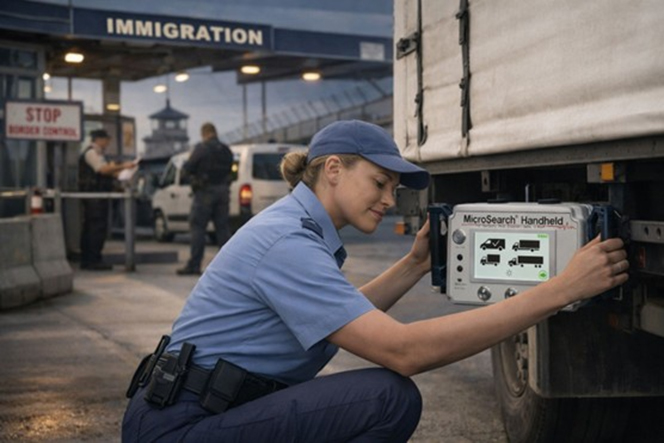
ENSCO has recently launched the MicroSearch® Handheld, the newest addition to its suite of human presence detection solutions. Designed for mobility, MicroSearch Handheld brings ENSCO’s field-proven technology into a compact, ultra-portable format that enables rapid, accurate detection in dynamic field environments.
The new system detects individuals hiding in vehicles or containers by sensing vibrations caused by the heart pumping blood through the human body, delivering the same core performance trusted by law enforcement, military, and correctional agencies worldwide since 2001. Its rugged, yet lightweight aluminum build, intuitive touchscreen and button controls, and single-operator deployment make it ideal for rapid use at border crossings, security checkpoints, and facility perimeters.
Portable X-ray and Backscatter Technology
Portable X-ray systems and backscatter technology are essential tools for border security, enabling portable inspection of cargo, vehicles, and individuals non-invasively.
Both of these technologies can significantly enhance border agencies’ capabilities, allowing for quick and effective inspections without the need for extensive manual searches. Their non-invasive nature reduces the risk of damaging cargo or causing discomfort to individuals being screened.
Backscatter technology uses low-energy x-rays to identify hidden objects, providing a non-invasive screening method. Unlike traditional X-ray systems, backscatter detectors capture images based on the radiation reflected off surfaces. This means it contains no harmful x-rays, so it is safe for both the operator and passengers. The disadvantage is that it does not have the depth penetration of a standard x-ray.
Videray Technologies has expanded its portfolio with the PXT with the industry’s first handheld 140kV transmission X-ray generator. The new system represents a significant advancement in ultra-portable inspection technology, extending the performance, safety, and versatility that have become hallmarks of Videray’s solutions.
Built on a patent-pending design, the PXT delivers enhanced penetration and image clarity while maintaining a compact, handheld form factor. When paired with Videray’s MTP+ detectors, the system is capable of penetrating up to 40 millimetres of steel with a 100-micron pixel pitch resolution, enabling operators to detect fine details during complex inspections.
The PXT’s capabilities are particularly relevant for border security and port-of-entry operations, where non-intrusive inspection tools are essential for identifying concealed threats within vehicles, cargo, and infrastructure components. Its portability allows inspection teams to conduct rapid, on-site examinations in constrained or remote environments without disrupting traffic flow or compromising safety.
According to Videray Technologies Founder and CEO Paul Bradshaw, the PXT reflects the company’s commitment to pushing the boundaries of portable X-ray inspection. “By working closely with our global partners and end users, we continue to unlock new inspection capabilities across security and non-destructive testing applications,” Bradshaw said.
RAVEN is Viken Detection’s next-generation handheld X-ray imager, delivering high resolution imaging and multi-threat detection in one compact device. Combining high-resolution backscatter and transmission imaging with AI-powered capabilities, RAVEN identifies materials, lead (Pb), precious metals, firearms, and radioactive sources—all within an ultra-slim, rugged design. Built for speed and reliability, its intuitive interface makes it ideal for border security and drug interdiction missions.
Portable X-ray Systems allow agents to conduct inspections without the need for large, stationary machines. By using portable x-ray systems, agents can see through objects to identify concealed items such as weapons or drugs. The main advantage of x-ray over backscatter is penetration. Flat screen portable x-ray systems are able to scan vehicles all the way through from top to bottom and side to side providing a complete cross section view of all items and materials. Some also have a technology called advanced materials discrimination, that provides coded visualisation that clearly differentiates materials based on their average effective atomic number (Zeff). The disadvantage of x-ray is that operators and passengers must keep a safe distance during operation.
3DX-RAY has introduced to their range of larger portable x-ray panels a new smaller form ThreatScan AS2 flat panel developed in direct response to users for a panel with all the capabilities of its larger counterparts, such as materials discrimination, but is small enough to able to be slipped under the seat of a car, between panels or into engine spaces.
In conclusion, the integration of chemical detection devices, heartbeat detectors, and portable X-ray and backscatter technology into border agency operations significantly enhances security measures. These tools enable agents to detect threats more effectively, more quickly and efficiently and streamline the screening process, ultimately contributing to safer borders. As global threats continue to evolve, the ongoing development and adoption of these technologies will be vital in ensuring national security.
You can meet the guys from 908devices and Videray at this year’s World Border Security Congress in Vienna