
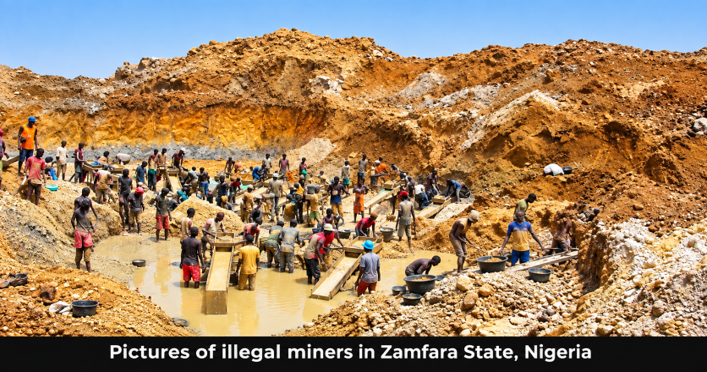
Illegal Mining And Armed Banditry In Nigeria: Implications For Border Security, Economic Stability And National Development
Illegal mining and armed banditry are no longer best understood as isolated criminal activities in Nigeria. In several parts of the North-West and North-Central regions, the extraction and movement of minerals have become intertwined with extortion, territorial control, kidnapping, arms trafficking and other illicit markets. The result is an informal conflict economy in which mineral resources can generate income for armed actors, while insecurity enables those actors to control access to mining areas and transportation routes. Recent research by WAANSA Nigeria similarly identifies the relationship between weak governance, unregulated artisanal mining and the expansion of banditry in rural communities.
The connection between mining and banditry operates through several channels. Several armed groups impose levies on miners, charge access fees, take a share of mineral output, provide or enforce protection, or take direct control of productive sites. The former Chief of Defence Staff Gen. Christopher Musa highlighted this in 2025 when he warned that armed groups increasingly rely on gold revenues to finance their operations, making it more difficult to dismantle their networks. It also reports allegations that proceeds from illicit mining have been converted into weapons and other equipment. One reported statement attributed to Kachalla Mati was: “We exchange the gold for weapons. We give them the gold, and they bring us the guns. Sometimes we sell it here; sometimes we send it to Dubai.” These accounts illustrate how an apparently local mining activity can become connected to transnational criminal supply chains.
The security problem goes beyond the financing of violence. Where government institutions have limited reach, armed groups can acquire influence over communities and economic activity. They may determine access to mining locations, impose payments on farmers and traders, restrict movement and regulate informal markets. WAANSA Nigeria describes this transformation as a shift from opportunistic extortion towards organised systems of control. Such conditions weaken public authority and make the recovery of territory more difficult because the armed group becomes embedded in the local economy.
The economic consequences for Nigeria are severe. According to the Nigeria Extractive Industries Transparency Initiative (NEITI), more than 70 per cent of mining activity nationwide is undertaken by artisanal operators working outside formal regulatory arrangements, while 80% of illegal mining activities are prevalent in some northern states. NEITI also estimates that Nigeriaan annual loses approximately US$9 billion through illegal extraction and mineral smuggling. Beyond fiscal losses, insecurity can destroy farms, interrupt trade, displace households, discourage investment and expose communities to environmental degradation. The economic burden is therefore shared by government, legitimate businesses and rural households.
Illegal mineral extraction becomes a border-security issue when gold and other commodities move through informal routes into neighbouring states and international trading centres. The source material identifies connections through Niger and Mali to wider Sahelian criminal networks and notes the role of external markets in the movement of Nigerian gold. This creates a chain involving extraction sites, local brokers, transporters, border crossings, traders and financial intermediaries. Effective intervention consequently requires more than operations at mining sites. Border agencies need better intelligence exchange, risk profiling, customs cooperation, financial investigation and coordinated action against smuggling networks.
Nigeria has responded with enforcement operations, mining restrictions and the deployment of Mining Marshals to disrupt unauthorised operations. Enforcement remains necessary, but a security-only approach is unlikely to eliminate the economic incentives behind illegal mining. The Ministry of Solid Minerals Development already identifies formalisation of artisanal and small-scale mining, mining-site mapping, extension services, access to finance and development of mining clusters among its activities. A stronger formalisation programme can move legitimate miners into traceable cooperatives and licensed markets while making it harder for armed groups to control production and trade.
The central policy challenge is to separate legitimate mineral production from criminal control. Nigeria needs a system in which minerals can be legally extracted, documented, transported, processed and sold, while illicit proceeds and weapons movements are actively disrupted. This requires coordination among mining regulators, security agencies, customs authorities, financial-intelligence institutions, state governments, local communities and regional partners. The objective should be to protect communities and national assets while ensuring that mineral wealth contributes to lawful economic activity rather than financing violence.
From WAANSA Nigeria security and border-governance perspective, the relationship between illegal mining, armed banditry, illicit arms flows and porous borders should be treated as a connected national-security problem. In summary, WAANSA Nigeria advocates an integrated approach combining security enforcement, border control, mining formalisation, financial intelligence and community development to prevent Nigeria’s mineral resources from financing banditry and transnational crime.
In conclusion, WAANSA Nigeria’s assessment is that illegal mining and armed banditry should be addressed as mutually reinforcing components of a wider illicit economy rather than as separate problems. The evidence available in the source article and recent Nigerian policy discussions indicates that weak regulation, insecurity, mineral smuggling and illicit financial flows can reinforce one another. The appropriate response therefore combines security enforcement with mineral-sector reform, border management, financial investigation, community participation and legitimate economic opportunities. Nigeria can reduce the space available to armed groups by making mineral production more transparent, disrupting criminal supply chains and ensuring that communities derive lawful benefits from the resources around them. The long-term objective should be a secure mining environment in which mineral wealth supports public revenue, employment and national development instead of sustaining violence and cross-border criminality.
By George-Okoli Francisco Chidi is the National 1st Vice President, West African Action Network on Small Arms (WAANSA) Nigeria