

Summary of the “EU Terrorism Situation and Trend Report 2025” from Europol
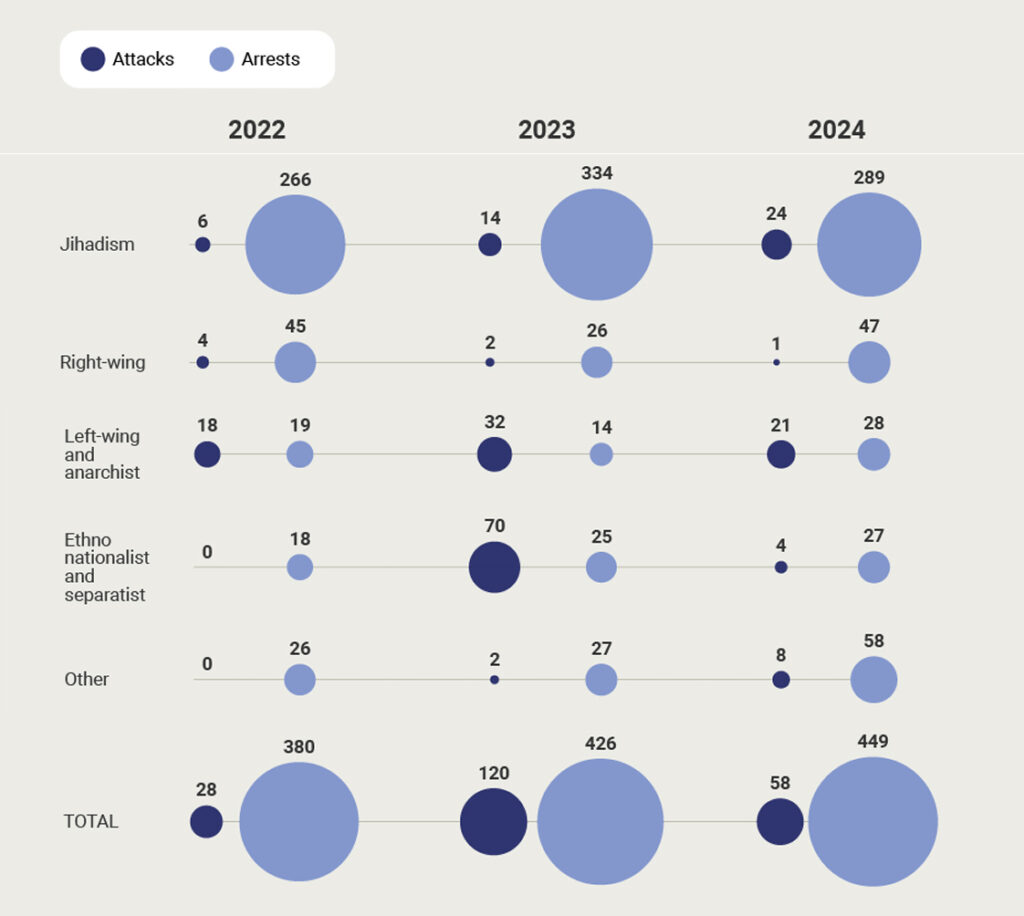
The “EU Terrorism Situation and Trend Report 2025,” published by Europol, provides a thorough and multifaceted examination of the terrorism landscape within the European Union. It reflects not only on the trends and patterns of terrorist activities but also on the effectiveness of counter-terrorism measures implemented across member states. One of the most striking observations in the report is the overall decrease in the number of terrorist attacks in the EU, a trend that contrasts sharply with the heightened levels of violence witnessed in previous years. This decline is seen as a result of several key factors, including the implementation of robust counter-terrorism strategies, enhanced collaboration among EU member states, and improved intelligence-sharing mechanisms, which have collectively contributed to the disruption of potential threats. However, while this reduction in attacks is encouraging, the report cautions that the threat level remains significant, necessitating ongoing vigilance and adaptive measures from law enforcement agencies.
The report provides a nuanced analysis of the changing nature of terrorist threats. It notes that while there are fewer attacks, the incidents that do occur are typically characterized by increased complexity and sophistication. This evolution is evident in the tactics employed by terrorist groups, which now often incorporate advanced methodologies and technologies. For example, many terrorist actors are utilizing digital platforms for recruitment, propaganda dissemination, and operational planning. The rise of encrypted communications has made it challenging for law enforcement agencies to monitor and intercept communications, complicating efforts to prevent attacks. The report underscores the importance of adapting counter-terrorism strategies to address these shifts, arguing that traditional methods may not suffice in tackling the new realities of terrorism.
A significant focus of the report is the persistent threat posed by jihadist terrorism, which continues to be a primary concern for security agencies across the EU. Despite the overall decrease in attacks, jihadist ideologies remain influential, inspiring individuals and small groups to commit acts of violence. The report highlights the risks associated with foreign terrorist fighters returning to Europe after participating in conflicts in regions such as Syria and Iraq. These individuals often possess combat experience and may have established networks that facilitate their reintegration into society, presenting a substantial threat. The potential for high-impact attacks perpetrated by self-radicalized individuals or small cells inspired by online extremist propaganda is noted as a critical area of concern. The report emphasizes the need for effective monitoring and preventive strategies to mitigate the risks posed by these returnees.
In addition to jihadist terrorism, the report draws attention to the alarming rise of right-wing extremism, which has emerged as a significant threat in various EU member states. This growing trend is linked to broader societal factors, including increasing polarization surrounding issues like immigration, national identity, and socio-economic inequality. The report documents several incidents of violence motivated by far-right ideologies, emphasizing that individuals inspired by these beliefs are increasingly willing to resort to violence. The report calls for a comprehensive approach to counter both left- and right-wing extremism, recognizing that failure to address the full spectrum of extremist ideologies could lead to further violence and societal division.
The report delves deeply into the factors that contribute to radicalization, emphasizing the importance of understanding the underlying causes to effectively prevent terrorism. It identifies key drivers of radicalization, such as social isolation, economic disenfranchisement, and exposure to extremist narratives, particularly through online platforms. The report advocates for community engagement and education as essential components of prevention efforts. Initiatives aimed at fostering social cohesion and resilience in communities are seen as vital in countering the appeal of extremist ideologies. By promoting dialogue and understanding among diverse groups, communities can build defences against radical narratives and create environments that discourage violence.
The impact of technology on the terrorism landscape is a central theme in the report. While technology can facilitate terrorist activities, it also offers opportunities for counter-terrorism efforts. Law enforcement agencies are encouraged to embrace technological advancements to enhance their capabilities in preventing and responding to terrorism. The report highlights the need for innovative approaches to combat online radicalization, including partnerships with technology companies to identify and remove extremist content from social media platforms. By leveraging technological tools and data analytics, law enforcement can improve their ability to monitor potential threats, identify individuals at risk of radicalization, and intervene before violence occurs.
International cooperation and intelligence sharing are emphasized as crucial elements in combating terrorism effectively. The report points out that the transnational nature of terrorist threats necessitates a coordinated response from EU member states and their international partners. Enhanced intelligence-sharing mechanisms, collaborative training initiatives, and joint operations are recommended to strengthen the collective response to terrorism. The report provides examples of successful cross-border cooperation, illustrating how collaborative efforts can lead to the identification and disruption of terrorist plots that span multiple countries. Such cooperation is essential not only for countering existing threats but also for anticipating and mitigating future risks.
The report concludes with a series of strategic recommendations aimed at improving the EU’s counter-terrorism framework. It emphasizes the need for member states to strengthen intelligence-sharing protocols and operational cooperation while fostering public-private partnerships to enhance cybersecurity and address online radicalization. The report also advocates for the development of tailored counter-radicalization programs that focus on local communities and at-risk individuals. By promoting awareness campaigns that educate the public on the dangers of extremism and the importance of reporting suspicious activities, the EU can empower communities to play an active role in preventing terrorism.
In summary, the “EU Terrorism Situation and Trend Report 2025” provides a comprehensive and nuanced view of the terrorism landscape in Europe. While the decline in attacks is a positive development, the evolving nature of threats—particularly from jihadist and right-wing extremist ideologies—calls for ongoing vigilance, adaptability, and innovation in counter-terrorism strategies. By addressing the root causes of radicalization, enhancing cooperation among member states, and leveraging technological advancements, the EU can better position itself to confront the challenges posed by terrorism in the future. The insights provided in this report are critical for policymakers, law enforcement agencies, and community leaders as they work collaboratively to safeguard public safety and promote social cohesion in an increasingly complex and interconnected world.
Download the full report at
https://www.europol.europa.eu/cms/sites/default/files/documents/EU_TE-SAT_2025.pdf