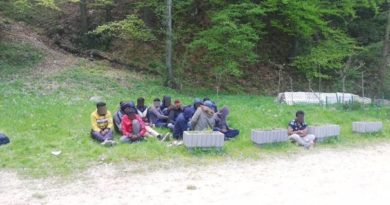

An international criminal organization that smuggled migrants and exploited them has been dismantled by the Spanish Civil Guard
Officers from the Civil Guard and the National Police have dismantled a criminal organization that brought foreign citizens of various nationalities into the country, in an irregular situation, and employed them on agricultural farms in the provinces of Albacete, Alicante, Castellón, Ciudad Real, Cuenca, Murcia, Valencia and Zaragoza.
The police operation, called “FRANCISKAN-EVEREST”, began in July 2024 and was carried out jointly by the Civil Guard and the National Police, with the collaboration of the Labor and Social Security Inspectorate of Albacete and Cuenca, ending with the arrest of 11 people and the investigation of another 2 for crimes, among others, of facilitating irregular migration and illicit trafficking of labor, assisting 322 people, of whom 294 were in an irregular situation.
Modus operandi
The complex modus operandi employed by the criminal network consisted of taking advantage of irregular immigrants who entered with tourist visas to countries within the Schengen territory, and, once in Spain, they were referred to other parts of the national territory where their labor rights were violated.
For its criminal activities, the organization was structured into different interconnected branches, one of which was dedicated to housing and employing these foreigners in the town of Villalgordo del Júcar (Albacete). In this town, the organization provided accommodation for the immigrants, cramming them onto mattresses on the floor in unventilated areas with few toilets, and in completely undignified and inhumane living conditions, utterly lacking the most basic hygiene and sanitation.
From this town, workers were transported daily to various agricultural areas. These journeys were made in vans, some of which were not in compliance with safety regulations. As a result, several traffic accidents occurred, one of which tragically resulted in the death of a Nepalese man.
Exorbitant commissions and sometimes payments “in food”
The organization imposed harsh working conditions, with shifts sometimes reaching 12 hours, charging exorbitant commissions for travel to workplaces, for the housing they sublet, and even for the food provided at the workplaces.
In many cases, the victims worked for the criminal organization for months without receiving any kind of financial compensation, only being rewarded for their work with very basic food.
Nine records in the towns of Villalgordo del Júcar and La Roda
In the final phase of the police operation, nine searches were carried out, eight of them in Villalgordo del Júcar and one in the town of La Roda, also in Albacete, seizing cash, checkbooks and checks, mobile phones, computer equipment, invoices, work reports, fraudulent documentation, documentation proving criminal activity and clandestine parallel accounting.
In addition, twelve vehicles have been seized, two of them high-end, and several bank accounts managed by the criminal organization have been blocked.
Assistance to potential victims
The operation left the migrants in a particularly vulnerable situation due to their lack of roots and economic resources. Therefore, from the outset of the police operation, efforts have focused on the social reintegration of the individuals housed by the dismantled organization. This has been achieved through collaboration with the Embassy of Nepal in Spain, cultural mediators, and Nepalese citizens’ associations.
Furthermore, the Spanish Red Cross has played a significant role in providing humanitarian aid and other recovery efforts for potential victims. They have provided food and warm clothing, and in collaboration with the Regional Government of Castilla-La Mancha, have arranged alternative accommodation for some of those whose situation was particularly vulnerable. The Red Cross is currently working to regularize the legal status of these individuals in Spain. The Spanish Government Sub-delegation in Albacete is also actively involved in this ongoing process.
The resettlement efforts have successfully relocated a significant number of the immigrants to other areas where they had established ties, and it is hoped that their social situation will gradually return to normal. Likewise, investigations are ongoing, and statements are being taken from these foreign nationals to determine whether they may have committed other criminal offenses.