
Czech Border Police: secunet technology significantly speeds up processes after EES introduction
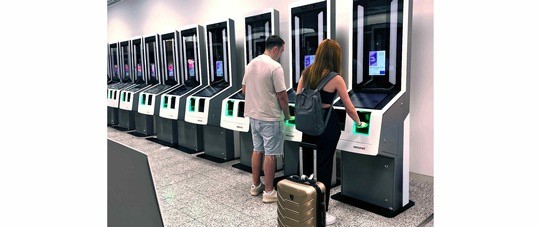
Following more than ten years of preparation and a 180-day roll-out phase, the EU’s Entry/Exit System (EES) went live in April 2026 in all 29 Schengen states. A significant number of these countries, including Germany, Austria, Switzerland and the Czech Republic, rely on border control technology from secunet. This technology ensures seamless integration with the EES, captures biometric facial images and automatically verifies travellers’ identities. Experience gained by the Czech Border Police during live operations confirms that secunet’s technology minimises waiting times for travellers despite the more complex EES processes. This is achieved through speedy automated border control systems and self-service kiosks where third-country nationals can enter their data in advance.
The Czech Republic is one of the few Schengen states to have opted for the immediate roll-out of full-scale operations. This roll-out took place as early as October 2025, meaning that reliable data on live operations is already available. With an average processing time of 24 seconds per person, the automated secunet easygate border control systems ensure a swift departure for third-country nationals. At the same time, the secunet easykiosk self-service kiosks are successfully fulfilling their role in speeding up the process: they relieve the burden on border control officers by shifting registration and data collection from the counters to the kiosks. In this way, the additional workload resulting from the EES has been effectively mitigated.
“We were well prepared for the EES roll-out, and the launch went very smoothly,” says plk. Mgr. Petr Malovec, Ph.D., Deputy Director of the Directorate of the Foreign Police Service, Police of the Czech Republic. “It was also important to us that, despite the additional workload, our staff could continue to focus on their core tasks and that travellers would continue to enjoy a pleasant travel experience. We have achieved these objectives too, and secunet’s solutions have played a key role in helping us do so.”
The secunet easygate border control systems were already in use in the Czech Republic prior to the introduction of the EES, but were upgraded to enable them to be used for the departure of third-country nationals as well. The Czech Border Police also rely on a comprehensive package of integrated solutions from the secunet border gears portfolio, such as secunet easytower facial recognition cameras and the secunet easyserver central server component. The solutions are entirely ‘Made in Europe’ and thus strengthen European digital sovereignty. They are in use at several airports in the Czech Republic, including Václav Havel Airport in Prague.
The EES is the most significant innovation in European border control since the introduction of the Schengen Area. In future, all border crossings by third-country nationals will be recorded biometrically.
The introduction of the EES forms part of the European Union’s Smart Borders Initiative. It requires third-country nationals to be registered with a facial image and four fingerprints at the Schengen Area’s land, sea and air borders. The data is stored in the EU’s central EES. This will make it easier in future to determine whether third-country nationals have exceeded the permitted length of stay. It is also intended to prevent illegal entry into the Schengen Area.