
GNR operations from north to south disrupt maritime drug networks: 1 arrest and seizure of 9 vehicles, 2 weapons of war and approximately 10,000 liters of fuel
The Portuguese National Republican Guard (GNR), through the permanent coordination between its Territorial Units, the Coastal and Border Control Unit (UCCF) and the Emergency Protection and Relief Unit (UEPS), carried out, the previous night, a series of operational interventions along the entire national coastline, from Esposende to the Algarve, aimed at combating organized networks associated with maritime drug trafficking. The readiness of the deployment and the territorial coverage capacity of the Guard allowed for the arrest of one suspect, the formal charging of another, and the interception of a minor, the seizure of two Kalashnikov assault rifles, nine vehicles, a boat with two engines, and approximately 10,000 liters of fuel intended for supplying high-speed vessels (EAV).
The geographical dispersion and the immediate response of patrols on the ground prevented the consolidation of logistical support points and drug unloading points on four distinct fronts:
- In the northern region, in the town of Fonte Boa, municipality of Esposende, the Braga Territorial Command intercepted, on the night of October 21st, at approximately 11:45 PM, a group of suspicious vehicles where preparations were underway for the assembly and launching of a vessel to support drug trafficking. The swift intervention resulted in the arrest of a 41-year-old man and the seizure of six vehicles (five with Spanish license plates and one Portuguese), a boat and two engines, approximately 1,500 liters of fuel, and two loaded Kalashnikov assault rifles with two magazines. Due to the escape on foot of at least three suspects, unmanned aerial vehicles (UAVs) from the Emergency Protection and Rescue Unit (UEPS) were deployed to search the area, and investigations are ongoing in coordination with the Judicial Police.
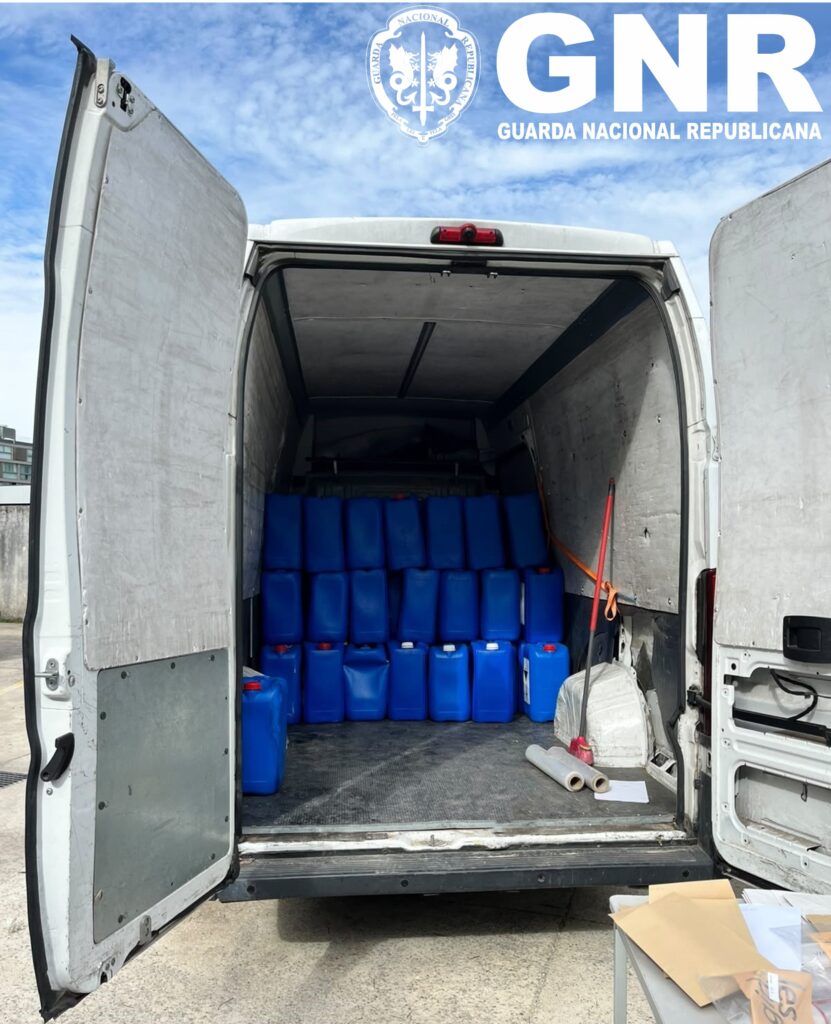
- At approximately the same time, in the Aveiras Service Area (A1), military personnel from the Lisbon Coastal Control Detachment of the UCCF intercepted a transport vehicle carrying approximately 100 jerrycans of fuel, and a 35-year-old Spanish national was charged. Following investigations on the ground and with the support of a patrol from the Castanheira do Ribatejo Territorial Post, a second abandoned vehicle was located in the Vala do Carregado area, also loaded with fuel, bringing the total seizure to two vehicles and 190 jerrycans containing approximately 4,750 liters of fuel intended for maritime logistical support.
- Simultaneously, on the southern border, an alert issued by the Castro Marim/Ayamonte Police and Customs Cooperation Centre (CCPA) detected the entry of an EAV (Electric Vehicle) into the Guadiana River, immediately mobilizing a UCCF (Unit for Combating Corruption and Transport) vessel, patrols from the Faro and Beja Territorial Commands, and UEPS (Special Police Unit) teams with drones. The coordinated police response forced the occupants to jettison the cargo into the water along the river, allowing for joint action with the Spanish Guardia Civil, which resulted in the seizure of 57 bales of hashish by the Spanish authorities, with the Guardia Civil collaborating in the recovery of 20 bales from the water.
- In the early morning of October 22nd, around 5:00 AM, the operation took place at the Baleeira Fishing Port in Sagres, following a report of a suspicious fuel transfer from a van to a light commercial vehicle. The on-site intervention, carried out by military personnel from the UCCF (Unidade de Custódia de Pesca e Conferenciado – Fishermen’s Fishing and Control Unit) and the Faro Territorial Command, through the Vila do Bispo Territorial Post and the Lagos Territorial Detachment, intercepted an individual and seized a light commercial vehicle and approximately 3,750 liters of fuel distributed among 150 jerrycans, completely thwarting the logistical refueling operation before the vessel fled by sea.
In the overall assessment of the four operational actions carried out, the coordinated intervention of the National Republican Guard culminated in the arrest of a 41-year-old individual, the formal charging of a 35-year-old individual, and the interception of a 15-year-old youth. This also resulted in the seizure of two Kalashnikov assault rifles and approximately 10,000 liters of fuel distributed in 420 jerrycans intended for the logistical supply of high-speed vessels. Nine light vehicles were also seized, including goods transport vehicles, a boat, two marine engines, several mobile phones, and equipment related to navigation and the assembly of structures supporting drug trafficking.


