
The Border Has Moved: Why the Future of Border Protection Is Predictive, Not Reactive
By: Gilad Ben Ziv, VP at Cognyte
For decades, border security was a question of where to build the fence. The agencies that succeed in the next decade will be the ones that can see a threat long before it reaches one.

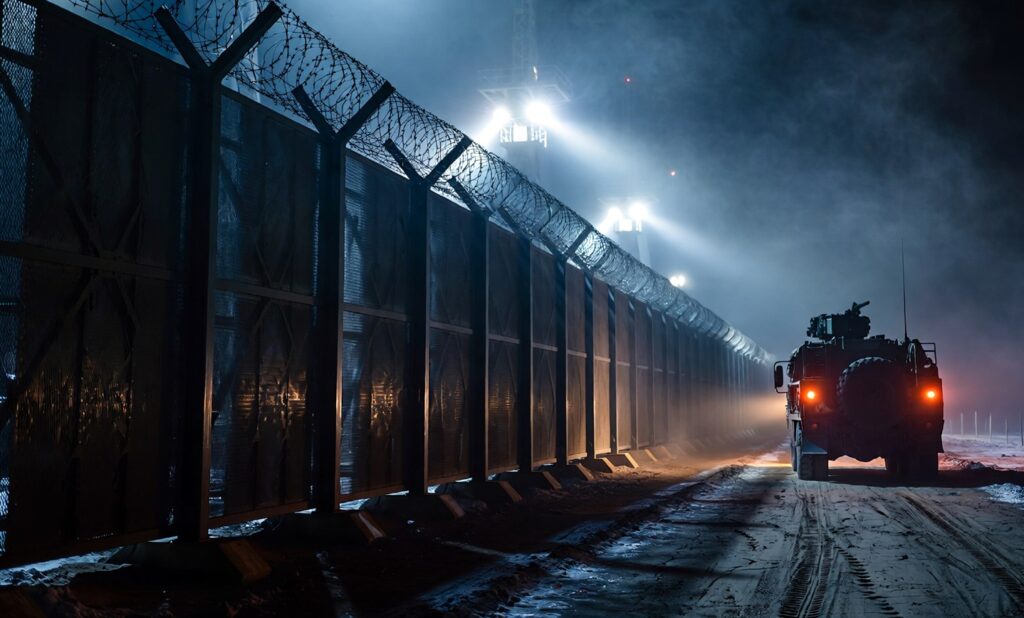
Border protection has entered a new era. The border is no longer a line on a map. It is a strategic pressure point where military tensions, transnational crime, irregular migration and hybrid warfare all converge. It’s no longer just a physical challenge. Protecting a border today means staying alert across the cyber and digital domains as well.
The core problem facing border security, military and law enforcement organizations today is that the threats have modernized. Many of the systems built to stop them have not. By the time a threat reaches a border, the chance to respond effectively has often already passed.

Why legacy approaches are falling behind
Most agencies still depend on isolated sensors and short-range detection. Radar, cameras, satellite feeds and ground sensors each sit in their own silo. No single operations center sees the full picture. Detection happens close to the border, which keeps border and maritime units locked in a reactive cycle. Many agencies are starting to add systems that integrate these sensors. However, the real gap is adding SIGINT and enriching the operational picture with intelligence from multiple sources to understand the complete threat.
Adversaries are exploiting every seam. Take hybrid warfare as an example. The Nord Stream pipeline explosions and the repeated damage to Baltic Sea data cables between 2022 and 2024 were not random accidents. They were deliberate strikes on critical infrastructure that no fence can defend against, designed to destabilize without triggering open conflict. A border unit watching only its physical perimeter would never see it coming.

Irregular migration tells a similar story. What has changed is that it is now increasingly weaponized. When Belarus allegedly funneled migrants toward the Polish and Lithuanian borders in 2021 and when Finland closed crossings in 2023 after accusing Russia of directing flows toward its checkpoints, migration became an instrument of state pressure. In both cases, the targeted states publicly attributed the surge to deliberate orchestration by a hostile neighbor, turning a humanitarian situation into a recognized security threat.
Irregular crossings at the EU’s external borders fell 26% in 2025 to under 178,000, the lowest level since 2021. The Western Balkan route is down 42% and the West African route down 63%. Frontex links these declines to deployment of advanced technologies and stronger operational cooperation with member states and partner countries. While some progress has been made, irregular migration remains a persistent challenge.
The maritime domain shows how adversaries now turn monitoring systems against the security forces using them. Smugglers and sanction evaders run “dark” fleets that switch off their AIS transponders or falsify their identities. In 2024, vessels near the Azores were detected transmitting AIS signals that matched no real ships. Hackers had created phantom targets to flood operators with false alarms and bury the real threat beneath them. The data meant to provide clarity was being used to manufacture confusion.

Cross-border crime is happening at an industrial scale according to Cognyte’s 2026 survey of European law enforcement, which reported shipping ports (28%), land borders, (20%), postal systems (15%), maritime borders & coastlines (11%), airports (11%) and unmanned systems (UAV, drones, 6%) as the most targeted entry points. Sophisticated criminal networks coordinate through encrypted apps, move money into cryptocurrency and deploy drones and narco-submarines. They thrive in the gaps between agencies that still operate in silos. The collaboration between terror organizations, smuggling networks and the infrastructure of organized crime, exploits these gaps.
Border security, military and law enforcement organizations that wait to see the threat at the fence is, by design, always one step behind. Adversaries who operate across domains, exploit the seams between agencies and move faster than any perimeter can react. The pattern is simple, these border threats are designed, built and set in motion long before they ever touch a physical border.
Seeing past the physical border
A predictive, intelligence-led approach that detects threats long before they reach a physical border is the clear trajectory of border protection.
- A vessel going dark stops broadcasting AIS and because that signal is satellite-tracked, the sudden silence is itself the red flag
- A trafficking network leaves digital traces months before its cargo ever moves
- A migration surge can surface in open sources such as social media before the first crossing
This is the principle behind Cognyte’s border intelligence approach. Rather than relying on siloed sensors, it fuses multi-domain data, including Signal Intelligence (SIGINT), Electronic Intelligence (ELINT), Imagery Intelligence (IMINT) and Open-Source Intelligence (OSINT), into a single operational picture. An AI-powered decision intelligence platform analyzes structured and unstructured data at scale to link actors, vessels and locations, surface anomalies and prioritize threats by risk and context.
The insights reach every tier of the agencies:
- Strategic planners allocating resources
- Analysts mapping suspicious patterns and anomalies
- Field operators acting in real time
The outcomes are measurable. In one recent case, a maritime enforcement organization used Cognyte’s border protection solution to identify a fleet of fishing vessels conducting covert fuel transfers to a sanctioned state and disrupted the operation.

The lesson for border and maritime units is clear. Fences and sensors still matter, but they no longer decide the outcome. The agencies that detects threats earlier, understand the broader context and act faster will set the standard for border protection. Intelligence, not infrastructure, provides the real operational edge.