
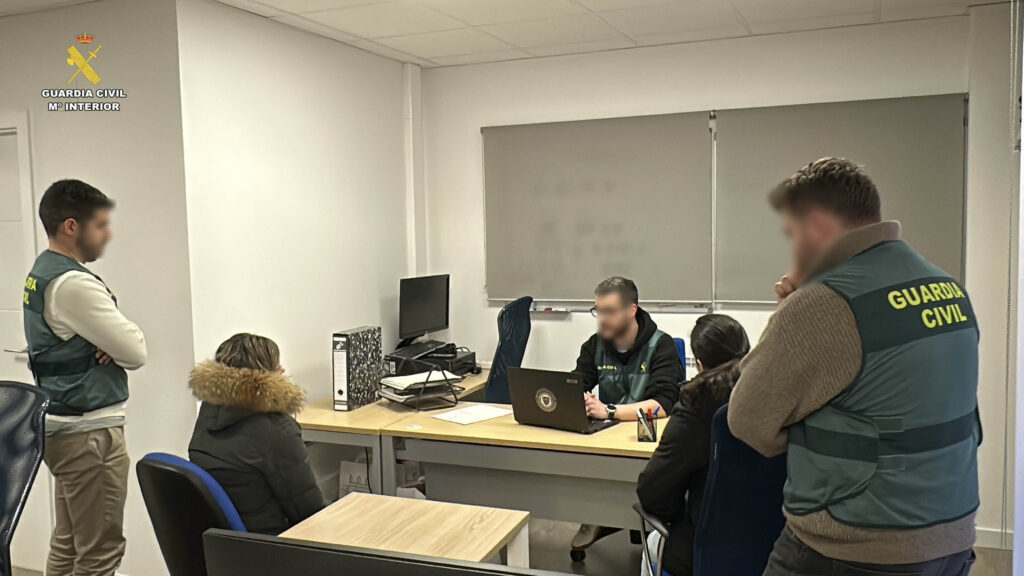
Twelve people are under investigation for acting as “money mules” for an international criminal organization
The Spanish Civil Guard, as part of Operation “Vicentius,” has investigated twelve people as alleged perpetrators of fraud, money laundering, and unauthorized access to computer systems. They are eight men and four women between the ages of 20 and 75, residing in different parts of Spain.
The person harmed by this criminal network suffered an economic loss of 432,000 euros in crypto assets.
Furthermore, the agents identified two Chinese residents as suspected members of the criminal organization and confirmed that the victim’s personal and banking information was also used to apply for two bank loans in her name totaling €10,450. This brought the initial fraud to a total of €442,650.
A complaint, the start of the investigation.
This operation began when the victim filed a complaint with the Civil Guard in La Rioja. The reason was the detection of bank transactions that she did not recognize and the impossibility of recovering the alleged investments she had made in a cryptocurrency platform.
In her complaint, she explained that she had been contacted months earlier by alleged financial advisors through digital platforms. They convinced her to make a small initial investment with the promise of extraordinary returns.
Remote Control Applications:
The criminals provided the victim with access to a fake website. There, they could view manipulated charts and data that showed their capital supposedly growing exponentially in real time. This led the victim to make successive, increasingly larger money transfers in order to maximize their earnings.
Once they had gained her trust, the scammers convinced her to install remote access software called “AnyDesk” on her electronic devices under the pretext of providing technical assistance for managing more complex operations. However, this application allowed the cybercriminals to take complete control of her computer and mobile phone, directly accessing her banking credentials and all her personal information.
With control of the equipment and bank passwords, those responsible for the plot completely emptied the victim’s personal accounts, as well as others that he managed from his computer devices, belonging to the company where he worked.
In addition to the stolen capital, they used the victims’ identities to obtain instant loans, increasing the financial loss. This sophisticated technical and psychological scheme allowed investigators to trace the international money laundering network associated with the fraud.
The suspects were the “money mules”
Those investigated in this operation acted as “money mules.” These individuals act as intermediaries, lending their accounts or opening new ones to receive the money defrauded from the victims.
Their primary function is to extract, move, fragment, and redistribute the funds they receive from the organization’s leaders. To do this, they make successive transfers to other accounts, both domestic and foreign, or convert the money into cryptocurrencies. These interconnected transactions make it difficult to trace the money, protect the identity of the true criminals, and conceal the illicit origin of the funds.
The investigation made it possible to trace up to 42 transfers directed to accounts located in Denmark, Lithuania, the United Kingdom and China, which facilitated following the path of the money and uncovering an international criminal network with branches in Europe and Asia.
The investigation remains open and focused on determining the final destination of the funds for their possible recovery.