Cocaine Corridors Beyond Brazil: How Transnational Routes Are Reshaping Border Security Frameworks
A model built for maps, not institutions
For most of the modern interdiction era, the cocaine corridor has been understood as a line on a map: a sequence of departure ports, transit waters, and entry points along which a commodity travels and at which it can be intercepted. Border, customs, and port authorities organized their detection architecture accordingly: chokepoints, container scanners, canine units, profiling matrices, and controlled deliveries. That model produced the seizure statistics by which operational success is still measured.
It is now structurally inadequate.
The corridors that connect South American production to European and North American consumption are no longer geographic facts. They have become institutional capabilities: reusable networks of companies, accounts, access points, and political relationships that can manufacture new routes faster than any single agency can close the old ones. A seizure degrades a shipment. Closing a chokepoint degrades a route. Neither degrades the corridor, because the corridor is the capacity to produce routes. Until that distinction enters operational doctrine, interdiction will keep winning engagements inside a contest whose terms it has not set.
The designations of the PCC and Comando Vermelho as terrorist organizations, effective 5 June 2026, do not settle that question. They sharpen it: are border services policing routes, or the institutions that generate them?
The corridor is an institution, not a route
The clearest evidence that corridors have become institutions did not surface at a border. It surfaced in São Paulo’s financial district.
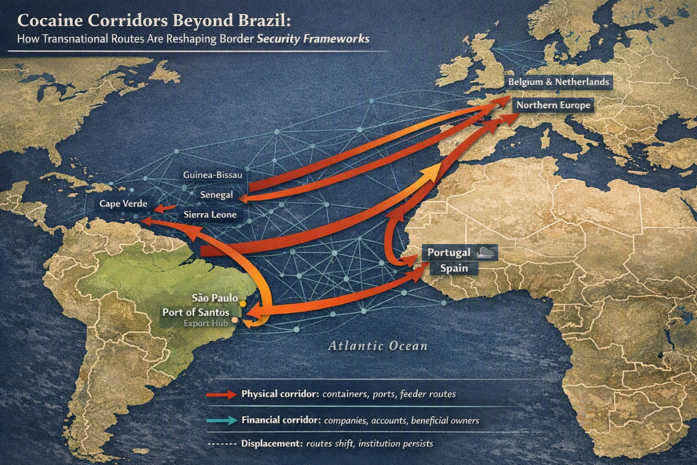
In August 2025, Operação Carbono Oculto exposed the architecture. The Primeiro Comando da Capital (PCC) had embedded itself across the legitimate fuel sector, from importation and distribution to retail, together with the investment funds and payment platforms that financed it, distributing illicit value through registered companies that presented to inspection as ordinary commerce. Read as a money-laundering case, that picture shows where criminal proceeds were hidden. Read correctly, it shows corridor infrastructure: the same enterprise that imports and distributes cocaine owning the fuel logistics that fund and conceal movement, the trucking that distributes, the terminal through which goods transit, and the financial vehicles that settle the accounts. Physical corridor and financial corridor are not adjacent systems that occasionally intersect; in the integrated criminal enterprise the PCC exemplifies, they are a single corridor expressed in two registers.
This is why interdiction-only strategies plateau. The architecture being targeted is not a pipeline that breaks when a valve is closed; it is a holding company that reallocates capital when an asset is lost. Carbono Oculto demonstrated the holdings; its sequel demonstrated the reallocation. When the first operation blocked the PCC’s payment platforms, the capability did not degrade; it regenerated. By May 2026, a second action, Operação Fluxo Oculto, had identified six new fintechs that replaced the institutions exposed nine months earlier, together moving more than R$26 billion (about US$5 bn) in atypical transactions between 2022 and 2025, with one platform alone taking in over R$1 billion (about US$190 million) in cash. Investigators found that the network had not contracted after the first operation but expanded, opening fresh shell companies to keep the same laundering pattern running. What changed the operating environment was not a seizure but a shift in visibility: the extension of bank-style reporting obligations to payment institutions, which began to close the blind spot the model had depended on.
More than two decades reconstructing organized-crime and narcotics networks inside São Paulo’s specialized units taught a lesson the seizure statistics obscure: the consignment is the disposable element, and the institution behind it is the durable one. For the border practitioner, the implication is uncomfortable but precise. The unit of analysis can no longer be the consignment. It must be the institutional substrate: the registered companies, freight forwarders, beneficial owners, and financial intermediaries that constitute the corridor’s reusable machinery. Everything that crosses a frontier is the output of that machinery, not the machinery itself.
Displacement is a design feature, not a failure
If corridors are institutions, route displacement is not evidence of enforcement failure. It is evidence that the institution is working as designed.
The European picture illustrates this. Europol’s 2025 Serious and Organised Crime Threat Assessment found that although maritime seizures fell at some major EU entry points during 2024, the volume of cocaine reaching the continent had almost certainly not declined; wastewater analysis across European cities pointed the other way. The flow had not contracted; it had redistributed.
Traffickers diversified toward secondary ports in countries with lighter scrutiny and expanded their chemical impregnation and concealment methods. They also continued to exploit reference-code fraud, a single technique that Europol’s assessments of port infiltration estimate has moved on the order of two hundred tonnes through two major northern European ports. With well over ninety million containers passing through Europe’s major ports each year and only 2 to 10 percent physically inspected, the structural arithmetic favors the corridor, not the inspector.
The same redundancy logic now drives the West African resurgence. Through 2025, French at-sea cocaine seizures reached a record annual total of roughly fifty tonnes across all theatres, surpassing thirty-nine tonnes in 2024, with the Gulf of Guinea a rising component, including a single 9.6-tonne haul from an unflagged vessel in September 2025. Brazil’s share of that transatlantic volume leaves South America containerized through the Port of Santos, Latin America’s largest port complex and the country’s principal cocaine export gateway, a fixed point the feeder routes reorganize around rather than replace. The traffic moving along the transatlantic “Highway 10” corridor is increasingly governed by a working partnership between Brazilian suppliers, above all the PCC, and Western Balkan networks that provide European distribution, while local brokers across Senegal, Guinea-Bissau, Sierra Leone, and Cape Verde furnish logistics, political cover, and in some cases purpose-built front companies.
Two operational facts deserve emphasis. First, the lusophone axis (Brazil to Guinea-Bissau and Cape Verde, onward to Portugal) is not incidental; shared language and commercial ties lower the transaction costs of building durable local infrastructure. Second, assessments of West African port screening indicate that inspection falls almost entirely on inbound cargo, leaving outbound containerized cocaine largely unexamined. That asymmetry is not a gap traffickers stumbled into. It is the route they engineered, and it will persist precisely because the intelligence burden of detecting export-stage concealment is one most transit states cannot yet carry.
Andean-Brazilian, Paraguayan, Bolivian, and Amazonian feeder routes behave the same way: each is a substitutable input to an institution that optimizes continuously across cost, risk, and enforcement pressure. Map any single route and the corridor reroutes. Map the institution and its capacity for rerouting becomes the target.
Where the physical corridor meets the financial corridor
The convergence of physical and financial flows is where contemporary corridor analysis either matures or fails.
Trade-based concealment is the connective tissue. The invoice that overstates the value of an ethanol shipment, the freight company that exists to consign one product and move another, the payment institution that nets distributor balances without ever identifying an end client: these are not laundering afterthoughts appended to a drug business. They are the mechanism by which the drug business and the legal economy become indistinguishable. The PCC’s “pocket accounts,” payment-institution balances nested inside other payment institutions and opened in the operator’s own name rather than the client’s, were not a clever trick. They were a deliberate second layer of opacity engineered to defeat exactly the beneficial-ownership screening that compliance regimes rely upon.
This is the analytical terrain that beneficial-ownership network analysis was built to address. The methodology, associated with organizations such as the Center for Advanced Defense Studies (C4ADS) and increasingly mirrored in U.S. Treasury and Department of Justice casework, rests on a single premise: the durable vulnerability is not the shipment but the ownership chain, the natural persons who ultimately control the fund, the fintech, the terminal lease, the haulage fleet. Sever a shipment and you cost the organization a quarter’s margin. Expose and freeze the beneficial owner and you cost it the corridor.
For border, customs, and port intelligence units, this requires an integration most agencies have not yet operationalized: the physical risk indicator and the financial risk indicator must be read on the same screen. A container anomaly and an adverse-media hit on the consignee’s ultimate owner are not two separate workflows owned by two separate directorates. They are two readings of one corridor, and treating them as separate is precisely the seam through which the corridor survives.
In practice that means a single risk model scored across both data sets, in which the container’s routing and the beneficial owner’s financial profile are weighed as one judgment rather than as a customs alert and a financial-intelligence file that meet, if they meet at all, only after the container has already moved.
Operating in the post-designation environment
The United States designated the PCC and Comando Vermelho as Specially Designated Global Terrorists on 28 May 2026, with the Foreign Terrorist Organization designation following on 5 June 2026, the first Brazilian groups ever placed on those lists. Their operational significance exceeds their symbolism.
Whether the terrorism characterization fits an organization defined by economic integration rather than ideological violence is not a question this analysis needs to settle. The operational point is narrower and harder to dispute: the Foreign Terrorist Organization and Specially Designated Global Terrorist framework is, at present, the U.S. legal instrument whose reach extends furthest past the trafficker and into the legal economy on which the corridor actually runs.
The framework sits atop existing counter-narcotics sanctions authority, used against the PCC since 2021. What the terrorism designation adds is precisely that reach. Material-support liability under 18 U.S.C. § 2339B does not stop at the trafficker; it extends to the fund manager who knowingly places cartel capital, the payment institution that settles it, the freight forwarder that moves it, and, where knowledge can be shown, the corporate counterparty that transacts with any of them, including conduct occurring entirely outside the United States. The U.S. Department of Justice has signaled that corporate material support to designated organizations is a white-collar enforcement priority, with whistleblower incentives attached.
For the practitioner, the effect is to convert functions once regarded as back-office compliance (sanctions screening, beneficial-ownership tracing, adverse-media monitoring, vendor cross-referencing) into instruments of corridor disruption that operate upstream of physical interdiction. The customs officer at the chokepoint and the compliance officer at the bank are now, whether either acknowledges it, working the same corridor at different points along its length.
The reframe carries genuine risk, and a serious analysis should name it. Aggressive material-support exposure can push facilitators deeper into opacity rather than out of business, accelerate jurisdictional arbitrage as financial structures relocate to lighter-touch regimes, and strain the public-private intelligence sharing on which detection now depends, if firms come to fear that cooperation invites liability. Designation is a powerful instrument precisely because it is broad; it is a hazardous one for the same reason. The operational challenge of the coming cycle is not whether to integrate financial-intelligence screening with physical interdiction. It is how to do so without collapsing the information flows that make either function work.
Attacking the corridor as a system
Conventional corridor analysis asks where the product is crossing. The contemporary corridor requires a different question: what is the institutional capability, and where is it structurally vulnerable.
Chokepoint interdiction remains necessary. It removes product, generates intelligence, and imposes cost. But on its own it manages a symptom of a system it does not touch. The cocaine corridors now reaching from Brazilian production-adjacent territory through West African transit hubs into European ports and North American financial infrastructure are integrated enterprises whose real center of gravity is the ownership chain: the companies, accounts, and beneficial owners that let a disrupted route be replaced before the seizure has cleared the evidence locker.
If the corridor is an institution, the measure of success must change with it. Seizure tonnage records what the corridor shed, not what it lost; it captures friction, not attrition. A metric honest to the target would track different quantities: beneficial owners identified and frozen rather than shipments intercepted, front companies dissolved rather than merely flagged, the reporting blind spots that let financial platforms regenerate finally closed, logistics capacity (terminals, fleets, and freight forwarders) stripped from the network’s reach, and facilitator relationships mapped and prosecuted. None of these is as photogenic as a pallet of seized kilos, and each is harder to produce. But they measure damage to the machinery rather than to its output, and the machinery is the only part the corridor cannot quickly rebuild.
The designations of 5 June 2026 hand border and financial-intelligence practitioners, for the first time, a common legal instrument aimed at that center of gravity. Whether it reshapes outcomes or merely generates paperwork will depend on a single discipline: the willingness to treat the corridor not as a place to be guarded, but as an institution to be dismantled. Until border strategy is measured by the institutions it disrupts rather than the routes it counts, the corridor will keep doing the one thing it was built to do: produce new routes faster than enforcement can close the old ones.
By Carlos Eduardo da Silva