
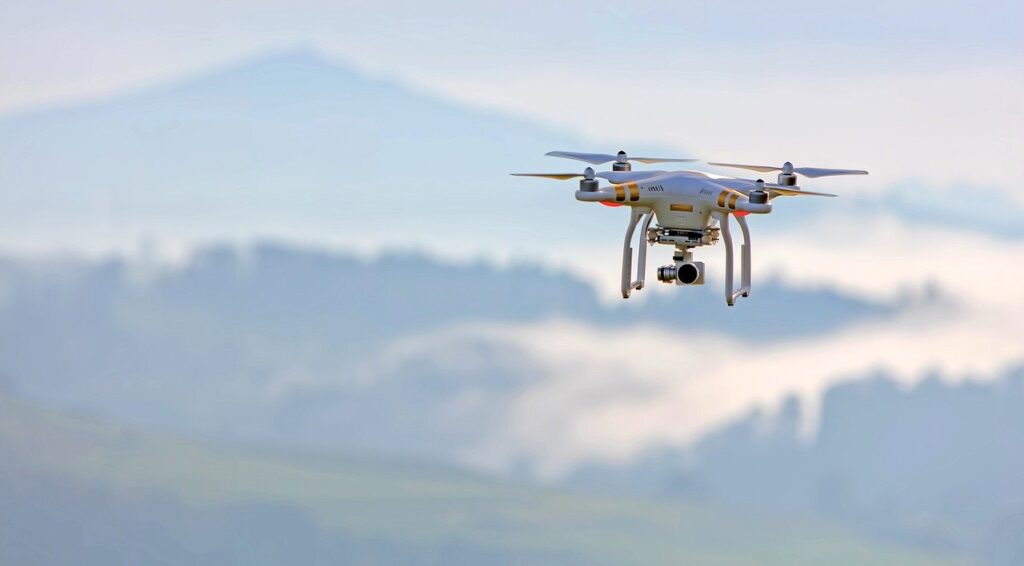
Drones and Borders: Fragmented Responses or a Global Framework?
By Adnane Kaab, International strategy, geopolitics, and foresight analyst, with a background as a senior officer in the Royal Moroccan Air Forces.
Borders have always reflected the balance between sovereignty, technology, and geopolitics. From watchtowers and patrols to satellites and biometric systems, each era has brought new tools that reshape the way states secure their frontiers. Today, drones are the latest link in that chain—notable for their affordability, agility, and capacity to shift tactical advantage away from traditional state instruments.
Drones have moved beyond military exclusivity: commercial quadcopters and increasingly autonomous systems are now in the hands of a wide range of actors. For states, they offer persistent surveillance and reduced operational costs; for criminals and insurgents, they provide discrete reconnaissance, micro-delivery, and new modes of harassment. This duality has created a dynamic contest at borders, where innovations on one side are rapidly mirrored or circumvented by adaptations on the other.
This article follows a three-step approach. It first examines the global strategic implications of drones for border management. It then focuses on Africa’s Sahel, where porous frontiers and weak institutions have produced compressed adoption cycles and novel threats. Finally, it contrasts these findings with Asia, where sustained geopolitical competition has driven significant investment in detection, neutralization, and regulatory control—most visibly along the India–Pakistan frontier.
These comparisons show that drones are more than tools: they are catalysts that reshape the balance between states and non-state actors. Will responses remain fragmented and reactive, or can states build a coordinated framework that anticipates the drone era rather than merely responding to it?
Drones as a Global Strategic Challenge
Drones have moved from the margins of warfare into the mainstream of global security, and borders are at the heart of this transformation. Once the privilege of state militaries, today’s drones—ranging from recreational quadcopters to sophisticated unmanned aerial vehicles (UAVs)—are inexpensive, widely available, and increasingly autonomous. This democratization of aerial technology has redefined what it means to monitor and protect borders.
At first glance, drones appear to strengthen state control. They extend surveillance capacity over difficult terrain, reduce the cost of patrolling vast frontiers, and provide real-time intelligence without exposing personnel to direct risk. For countries with extensive land or maritime boundaries, drones offer the promise of persistent vigilance where traditional ground assets are either too expensive or impractical.
Yet, the very features that make drones attractive to governments also empower non-state actors. Smugglers, traffickers, and insurgent groups have been quick to exploit drones for reconnaissance, delivery, and even diversionary tactics. What was once the exclusive advantage of states has become a contested domain. In this sense, drones do not merely add a new layer to border security—they alter the balance of power between state and non-state actors.
This dual-use nature of drones explains why borders worldwide are increasingly vulnerable. A drone can carry contraband across a frontier just as easily as it can transmit live imagery of patrol patterns. The result is an arms race of sorts: every advance in border surveillance is met by an adaptive response from those seeking to bypass it.
Seen in this light, the drone phenomenon is not a technical issue but a geopolitical one. It illustrates how technological diffusion can erode the monopoly of states over security tools. And this tension becomes particularly acute in regions where governance and resources are uneven.
It is here that Africa presents a compelling case. With vast, porous frontiers and complex transnational flows, the continent offers a vivid example of how drones amplify existing challenges. Understanding the African experience is therefore essential before turning to Asia, where state capacities and geopolitical rivalries drive a very different response.
Africa — an acute case: compressed adoption cycles and border consequences
The Sahel offers one of the clearest illustrations of how drones have shifted from niche technologies to an immediate strategic problem for border security. For decades, vast porous frontiers and fragmented state authority facilitated smuggling, trafficking, and insurgent mobility. Today, unmanned aerial systems (UAS) amplify those vulnerabilities—and not just in the hands of militaries. Non-state actors, from armed groups to traffickers, are accelerating adoption cycles, replicating battlefield innovations almost in real time.
The pace of this diffusion is striking. First-person-view (FPV) drones, popularized in Ukraine in 2022 for their agility and precision, appeared in Sahelian theatres by 2024—a lag of barely two years. Fibre-optic-guided variants, designed to bypass conventional RF jamming, emerged in West Africa within 12–18 months of their first use elsewhere. With AI-enabled drone swarms already demonstrated in 2025, the real question is no longer if such capabilities will reach the Sahel, but how soon and in what adapted form.
For border security forces, this compression of adoption cycles is critical: it shrinks the window for adaptation across four dimensions simultaneously—doctrine, procurement, inter-agency coordination, and legal authorization. Patrol models designed for road interdictions cannot instantly pivot to counter small, low-altitude aerial drops. Attribution compounds the challenge: drones launched from across a border create immediate diplomatic and operational dilemmas—who has the authority to intervene, to collect forensic evidence, or to trigger bilateral mechanisms?
What is new, and particularly destabilizing, is the diversity of actors involved. Militants and insurgents deploy commercial quadcopters for reconnaissance, mapping patrol routes, tracking convoys, or guiding supply movements through unmonitored desert corridors. Traffickers and organized crime groups, meanwhile, exploit drones to scout safe passages for arms, drugs, and even migrants—bypassing traditional checkpoints. In some instances, they have orchestrated aerial micro-drops of high-value contraband across lightly monitored borders.
These developments echo wider global dynamics. Africa illustrates the collapse of the traditional lag between innovation and diffusion: the line between state, insurgent, and criminal uses of drones is increasingly blurred. The result is a profound challenge for border management in the Sahel, where UAS are no longer a theoretical future threat but a disruptive factor shaping the everyday realities of security forces, local communities, and cross-border governance.
While the Sahel highlights how weak governance amplifies the disruptive potential of drones, Asia presents a contrasting scenario—one where strong states and regional rivalries have driven more proactive and technologically sophisticated responses.
Asia and Strategic Comparison
In Asia, drones intersect with powerful states and entrenched geopolitical rivalries. The dynamics here are less about fragile capacity than about how strong states adapt technologies within competitive security environments.
One prominent example is the India–Pakistan border, where quadcopters and modified commercial drones have been repeatedly used to drop weapons, explosives, and narcotics across the Line of Control. These incidents illustrate how drones are not simply tools of surveillance but instruments of hybrid warfare. The responses have been swift: India has deployed radar-equipped anti-drone systems capable of jamming or even physically neutralizing hostile platforms, while Pakistan has tightened its doctrine and border surveillance, reframing drones as part of its ongoing strategic contest with India.
Beyond South Asia, China represents a different model—one defined by scale and control.
Beijing integrates drones into its extensive border security architecture, from Xinjiang to the South China Sea, while also imposing strict domestic regulation on ownership, registration, and flight zones. Counter-drone technologies, including directed-energy weapons and AI-enabled monitoring, are embedded into a broader security framework, reflecting a doctrine in which drones are simultaneously an asset and a potential threat to state authority.
Taken together, these Asian experiences offer a sharp contrast with Africa. In the Sahel, non-state actors innovate quickly against weak governance, exploiting porous borders and fragmented coordination. In Asia, by contrast, states remain firmly in control: technological investments, electronic warfare capabilities, and regulatory regimes create a much tighter race between drone adoption and countermeasures.
The comparison underscores a broader lesson. Drone mitigation is not simply a question of technology, but of governance capacity and geopolitical posture. For Africa, Asia’s experience suggests that even under resource constraints, coordinated frameworks—combining technology, regulation, and regional cooperation—can reduce vulnerabilities. At the same time, it is also a cautionary tale: in highly competitive regions, drones risk becoming not only tools of border insecurity but also instruments of strategic escalation.
The evolution of drone technologies in border security reveals more than a tactical shift: it exposes the resilience—or fragility—of governance systems. In Africa’s Sahel, drones magnify pre-existing vulnerabilities, shortening the lag between innovation and diffusion and enabling insurgents and traffickers to contest state authority across porous frontiers. In Asia, by contrast, drones are embedded within state-centered rivalries, where technological investment and institutional foresight have produced more systematic countermeasures.
This divergence underscores a critical insight: drones are not simply new tools in the arsenal of states or non-state actors. They are catalysts that test the adaptability of governance, the capacity for regional coordination, and the ability to integrate technology into coherent security strategies. Where capacity is weak, drones exacerbate disorder; where capacity is strong, they become triggers for doctrinal and technological innovation.
The challenge now is global. Whether in Africa, Asia, or beyond, the question is whether responses will remain fragmented and reactive, or whether states can build coordinated frameworks that anticipate the drone era rather than merely endure it. Meeting this challenge will require not only advanced counter-drone systems but also anticipatory governance and cross-border cooperation—whether through African regional bodies, Asian security architectures, or multilateral platforms such as the UN, NATO, or the G20.
The drone era is here to stay. What remains uncertain is whether it will deepen existing fractures in the international order, or whether it can drive new forms of collaboration that make borders not just lines of division, but laboratories of collective security.