Trends And Challenges In Refugee And Mass Migration:The Case Of Mongolia
Throughout human history, millions of people have been forced to abandon their homelands and the lands where they lived their ordinary lives, for various reasons, fleeing to neighboring and border countries.
In recent years, the factors generating refugees have continuously evolved. While the term was initially understood to refer only to those fleeing wars and armed conflicts, the concept of “refugee” has expanded to encompass those fleeing unlawful persecution on the basis of “…race, religion, nationality, membership of a particular social group, or political opinion…” Furthermore, there is a growing international tendency to recognize as refugees those who are forced to flee to protect their lives and health due to environmental degradation and ecological disasters.
Determining who qualifies as a refugee at the international level and how protection and assistance should be provided has long been a complex matter. Since the early twentieth century, the development of international legal consciousness has given global scope to efforts aimed at assisting refugees. This is linked to the fact that the major world wars drew numerous countries into their orbit, giving rise to large numbers of refugees as a consequence of resulting social, political, and economic crises of international scale.
Although the refugee issue has remained a focus of global attention, it has become an issue of unavoidable urgency in recent years due to escalating tensions worldwide. According to the 2024 report of the United Nations High Commissioner for Refugees (UNHCR), approximately 123 million people have been forcibly displaced globally.
Global And Regional Trends And Challenges In Mass Migration
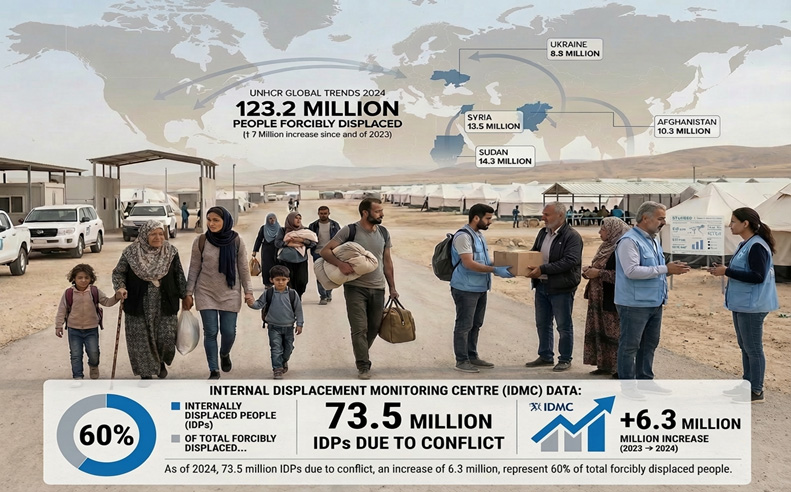
According to the UNHCR Global Trends 2024 report, the number of people forced to flee because of conflict, violence, human rights violations, and events seriously disrupting public order rose to 123.2 million. This was 7 million people, or 6 percent, more than at the end of 2023, and no less than one-third of that total consisted of citizens of Sudan (14.3 million), Syria (13.5 million), Afghanistan (10.3 million), and Ukraine (8.8 million). Of the increase recorded in 2024, 20.1 million were displaced within their own countries, while 5.4 million were refugees and asylum seekers.
According to the Internal Displacement Monitoring Centre (IDMC), by the end of 2024, 73.5 million people remained displaced within their own countries because of conflict, an increase of 6.3 million. Internally displaced persons (IDPs) therefore accounted for the majority—60 percent—of all forcibly displaced people.
This increase is linked to intensified conflict in Sudan and Myanmar, escalating gang violence in Haiti, and a revision of IDP figures for Colombia.
The primary causes compelling refugees to forcibly abandon their homelands include:
- Discrimination and political persecution on the basis of religion, nationality, social group membership, or ethnicity;
- War and armed conflict;
- Gender-based orientation and discrimination;
- Famine;
- Natural and climate-related change.
Based on observations from international experience and lessons learned, when refugees settle in large numbers over a long period and become naturalized, they may pose the following risks and threats to the host country. These include:
- Altering the social structure and composition of the native population, thereby creating conditions that may fuel nationalism, exclusion, discrimination, hatred, and extremism;
- Due to differences in ethnicity, language, culture, race, and religion, refugees may erode long-established social values developed over thousands of years by the native population;
- Bringing changes to employment, social welfare, and livelihood support systems;
- Creating flows of low-skilled, low-cost labor, intensifying disparities in wealth and living standards, and widening the gap between rich and poor, which may lead to social stratification and instability;
- Increasing crime rates and worsening the criminal situation, thereby negatively affecting the country’s internal sovereignty, territorial integrity, and the inviolability of its borders;
- Individuals of unclear origin or background potentially damaging the country’s reputation and attempting to protect their interests through both legal and illegal means.
Moreover, extremist groups united by ethnicity or religion may incite unrest and render governance ineffective, rendering the rule of law unenforceable. This is evidenced by the bitter lessons drawn from refugee-related crises in France, Germany, and other European countries.
Although the security risks and multidimensional challenges associated with refugees are numerous, historical evidence demonstrates that refugee movements are not limited to humanitarian concerns alone. They generate profound political and security risks to the internal security of states. In recent years, there has been a growing tendency among host-country governments — both current and prospective — to perceive incoming refugees as threats to domestic order and security. Refugees have been associated with violence, crime, violations, poverty, and unemployment, all of which constitute adverse social phenomena.
With respect to countries receiving refugees, low-income countries — which account for 0.5 percent of global GDP and 9 percent of the world population — have taken in 18 percent of all refugees. In contrast, middle- and high-income countries — which represent 99.5 percent of global GDP and 91 percent of the world population — have received 82 percent of all refugees, reflecting a deeply imbalanced distribution.
From this it can be concluded that poor and less-developed nations, lacking the capacity to restrict, refuse, or find solutions for refugees, are in effect compelled to receive them at the cost of further deteriorating their own social and economic conditions.
Trends And Challenges Of Mongolian Internal Migration
Mongolia covers a total area of 1,566,000 km², has a border of 8,252.658 km, and ranks among the countries with the lowest population density relative to its territory (2.04 persons/km²). Of its total border length, 43.2 percent — or 3,543 km — is shared with Russia, and 56.8 percent — or 4,709.658 km — with China. As a sparsely populated country, Mongolia occupies a unique position with respect to refugees, a position that entails both advantages and serious risks. According to Mongolia’s 2024 census, the country has a population of 3,419,193, of whom 1,659,327 — or 48.5 percent — reside in Ulaanbaatar, reflecting a pattern of internal migration concentrated toward the capital.
According to a 2026 assessment by an international meteorological research team, Mongolia ranked first among the world’s ten coldest countries (-33 to -55.3°C / -34.3 to -67.5°F), and its coldest localities reach about -40°C / -40°F. Its harsh, dry, high-altitude terrain and its remote, landlocked position shape an extreme continental climate. Mongolia’s indigenous population and nomadic pastoral livelihood have adapted to these severe conditions.
Mongolia has traditionally been a country of outward migration rather than a recipient of immigrants. However, in recent years, the nature of migration has been changing as a result of regional movements, shifting economic conditions, and geopolitical transformations. Irregular (undocumented and unauthorized) and mass migration is largely associated with the pursuit of employment, education, improved livelihoods, and greater socioeconomic opportunity.
As a developing country located between two major powers, Mongolia’s friendly cooperation with its neighbors—and the evolving substance of those relations—constitutes an important factor affecting its border space and border security. Given its geographic position, Mongolia pursues friendly relations with its neighbors, refrains from interfering in relations between them, does not station or allow the transit of foreign troops through its territory, does not join military alliances in peacetime, and has declared its territory a nuclear-weapon-free zone. This reflects Mongolia’s priority of maintaining balanced, friendly, and peace-promoting relations with its neighbors.
China maintains territorial disputes with certain neighboring Asian countries, including India, Japan, and the Philippines. Russia and Ukraine have been engaged in armed conflict since February 24, 2022, which continues to this day. Nevertheless, Mongolia ensures its own border security independently and has no unresolved territorial or border disputes with its neighbors. Relations between the parties have reached the high level of multi-dimensional strategic partnership. While there are incomparable differences in territory, economy, population, and military-political capacity, it is worth noting that border protection is carried out by Border Troops on both sides, and that ethnically similar groups (Tuvans, Buryats, Kalmyks, Inner Mongolians, etc.) live and practice pastoral herding in the border zone regions on both sides of the frontier.
While Mongolia’s security environment currently appears relatively favorable, it cannot be denied that the changes unfolding across global relations may give rise to entirely new and unanticipated threats and challenges to border security and, more broadly, to Mongolia’s national security.
In connection with the Russia–Ukraine conflict, following Russia’s declaration of mobilization in 2022, tens of thousands of Russian nationals entered Mongolia legally through its border (with crossings by Russian citizens increasing 16 to 20 times ), the majority of whom were likely ordinary civilians fleeing the war and conscription. This situation has raised the urgent question of whether the relevant state agencies — including immigration, intelligence, and border authorities — would be adequately prepared if refugees were to arrive at the border in the hundreds or thousands.
The primary responsibility in such a scenario would fall on the border military units and subdivisions, as well as border control agencies performing duties at the state border.
The border protection authority, within the scope of its legally defined powers, detains individuals at the state border and manages border-crossing operations on the basis of travel documents conferring the right to cross the state border. However, there are currently no operational regulations or procedures governing the handling of refugees. In such a situation, a series of questions would arise in rapid succession — including how to classify the individuals concerned and how to proceed. Going forward, under both international and domestic legal principles, the complex and sensitive question of determining the status of refugees — whether they have or have not violated the state border, or whether they are asylum seekers — is likely to become a pressing issue.
Although Mongolia has not joined the 1951 Refugee Convention or its 1967 Protocol, the government has made several attempts to accede. For example, in 2009 the question of joining the Refugee Convention was discussed at a Cabinet meeting and by the National Security Council. Article 18(4) of the Constitution of Mongolia, adopted in 1992, provides a constitutional basis for granting asylum, on the basis of a well-founded request, to foreign nationals and stateless persons persecuted because of their beliefs, political or other activities, as well as to persons acting in the pursuit of justice.
Mongolia has continued to honor its commitments regarding the legal status of refugees, upholding the principle of non-refoulement — the cornerstone principle of refugee law prohibiting the return of refugees to countries where their lives or freedom are at risk.
In cooperation with the UNHCR Asia and the Pacific Bureau, Mongolia has twice developed preparedness plans in recent years, taken measures to strengthen national resilience, and successfully conducted joint international exercises—measures that reflect the policy actions being taken by the state in this area.
In Mongolia, unregulated internal migration poses a more serious threat to border security than the issue of external refugees. It has been assessed that “unregulated, capital-directed internal migration has in some regions assumed dimensions akin to internal displacement, depopulating border and frontier territories and exerting a negative impact on border security.”
This internal migration has become a significant issue with direct implications for Mongolia’s national security.
Тrends:
- Outward migration is increasing, particularly among young people seeking employment and education abroad;
- Regional (inter-Asian) movement is intensifying;
- Inward domestic migration toward urban centers is rising, creating over-concentration, placing additional pressure on urban development and infrastructure;
- Ecological pressures: severe climate change, desertification, low population density, and population concentration;
- Scarcity of drinking water resources, excessive water hardness due to high mineral content;
- The risk of refugees and irregular or mass migrants transiting through Mongolia is increasing as a result of the Russia–Ukraine war. In particular, following the mobilization order of September 1, 2022, pressure at the border intensified sharply, causing disruptions to port operations — a concrete example demonstrating that Mongolia cannot remain insulated from the internal affairs of its neighbors. Given Mongolia’s geopolitical situation between two major powers, while it must avoid entanglement in their internal matters, it is in practice absorbing the burden at its own borders;
- Lack of alignment with international treaties: 147 states have acceded to the 1951 Convention, but Mongolia has not yet joined it. In such circumstances, Mongolia’s ability to make full use of international financing and technical assistance is limited;
- National security risk: The National Security Concept explicitly provides for the establishment of preparedness measures to guard against the mass influx of foreign refugees.
Challenges:
- Weak legal framework for monitoring and regulating irregular migration;
- Capacity of border protection, registration, and information systems;
- Human rights issues (protection of irregular or undocumented migrants, labor exploitation);
- Social and economic pressure (employment, housing, public services);
- Internal population migration and depopulation of border territories;
- Changes in the internal conditions of neighboring countries — in particular, the potential emergence of refugee situations arising from armed conflict at the state border — have become one of the most urgent priority challenges.
Conclusions & Recommendations
The refugee issue is a pressing global challenge that must be approached with respect for human rights. However, for Mongolia — a country with a small population and a vast territory — the imperative of ensuring national security must always take precedence. Although the United Nations and the broader international community have repeatedly urged and encouraged Mongolia to accede to the 1951 Refugee Convention, the question of whether to join should be subjected to thorough research and broad public deliberation.
At present, the refugee issue in Mongolia is governed by national legislation and other international legal instruments, taking into account the internal conditions of neighboring countries, the actual social and economic realities of Mongolia, as well as its geographical location and climatic characteristics.
The World Bank’s Groundswell Report estimates that by 2050 up to 216 million people across six regions of the world may move within their own countries —a finding that suggests internal migration in Mongolia may continue to increase.
Unregulated internal migration directly impacts Mongolia’s border security and national security, bringing with it adverse consequences including the depopulation of border regions, the weakening of border control, and the intensification of urban over-concentration.
Accordingly, the proper management of internal migration is essential for ensuring economic development and social stability. To this end, it is necessary to further strengthen state policy, the legal environment, and international cooperation.
In particular, with respect to preventing the influx of refugees and taking pre-emptive measures, it is advisable to give special attention to the full implementation of Article 3.1.2.3 of the National Security Concept of Mongolia, which states: “A preparedness system shall be established to prevent the mass crossing of the state border by foreign refugees and the occurrence of sudden, uncontrolled situations, and a comprehensive set of legal, political, and diplomatic measures shall be taken.” This includes training and exercising state agencies and personnel in response policy planning for such contingencies, building and enhancing national resilience and preparedness.
By Colonel Gerelt. Khulan, Ph.D., Associate Professor, Institute for Border Studies, General Authority for Border Protection, Mongolia