Climate Migration and Natural Disaster Response: Securing Borders Without Closing Doors
Know who is moving and why — without impeding the humanitarian imperative to protect and process vulnerable environmental refugees.
Around the world natural disasters such as droughts, wildfires, floods, and food crises are displacing communities at an alarming rate. The Internal Displacement Monitoring Centre (IDMC) estimates that in 2023 alone, weather-related and natural disasters triggered 26.4 million new internal displacements spanning 148 countries and territories. And the International Organization for Migration estimates that weather-related disasters have triggered more than 218 million internal displacements in the past decade.
Not only did climate-related disasters trigger more than half of new reported displacements in 2022, but nearly 60 percent of refugees and internally displaced people reside in countries that are among the most vulnerable to climate change, according to the UN Refugee Agency, UNHCR.
Moving forward, projections of climate migration and displacement by 2050 range from hundreds of millions to more than a billion people, mostly within and between climate vulnerable countries of the Global South. A recent study found that unusually dry conditions were already a predictor of increased migration from Central America to the United States in recent years. Given these prognostications, mass migration has been a featured topic in remarks on climate change by the U.S. Secretary of Defense and Director of National Intelligence.
In 2024, three months after major flooding hit southern Brazil, at least 386,000 people were displaced — this after three previous incidents of flooding hit the region within 18 months. In 2022, Pakistan saw one third of its territory submerged by flooding, displacing 8 million people, including thousands of Afghan refugees. One current ongoing example of environmental-related migration is in the Oceania region of the South Pacific, where nearly a third of Tuvalu’s citizens have entered a ballot to relocate to Australia under the world’s first climate-linked visa program that allows up to 280 Tuvaluans annually to live, work, and study in Australia due to rising sea levels making their nation uninhabitable.
These displacements only add to the millions who migrate from one country to another seeking improved economic opportunities, safety from wars and conflict, and to reunite with family.
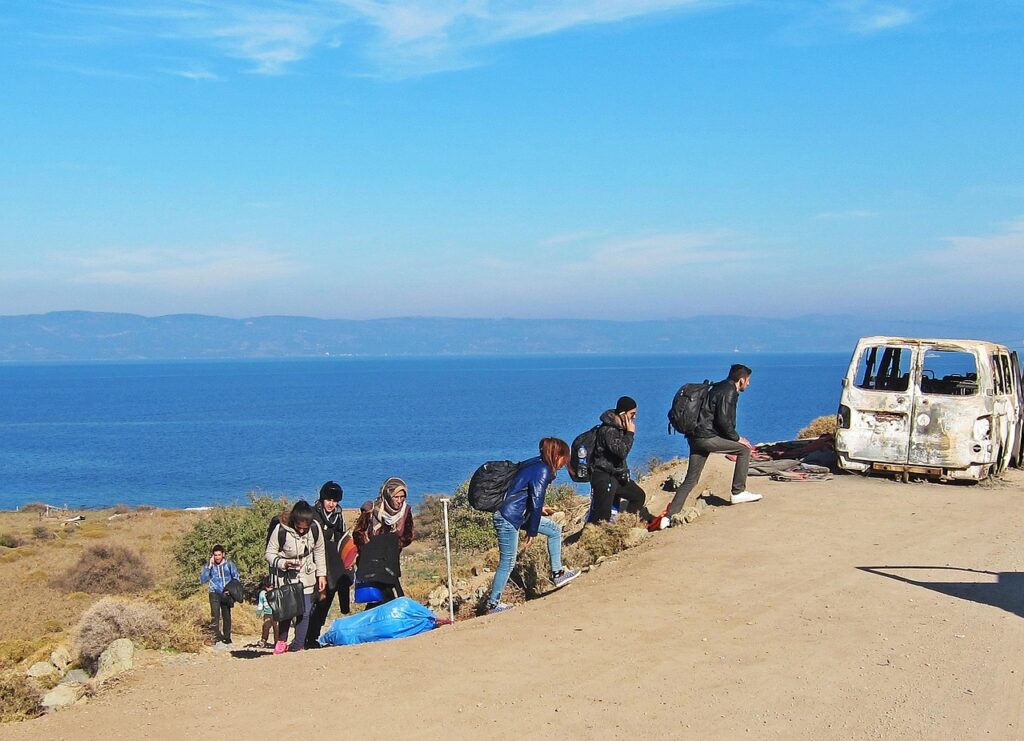
As climate-driven migrants increasingly seek refuge across international borders, governments and border agents face a dual imperative: Accelerate humanitarian intake while safeguarding national security. As the number of climate migrants swell, it can provide the opportunity for dangerous individuals — terrorists, human traffickers and members of international crime rings — to enter their new nations undetected. Security officials in the U.S. and Europe have noted the risk of individuals with ties to terrorist organizations attempting to exploit large-scale migration flows to enter countries undetected.
Irregular Migration Presents Border Security Challenges
Climate migration presents complex security challenges for both migrants and host countries, including risks to personal safety from criminal exploitation during transit, and potential strain on resources and public services in receiving areas, notes the Carnegie Endowment for International Peace.
It also presents challenges for border professionals for background vetting, who must streamline identity verification while also thwarting the entry of potentially dangerous individuals. In large‑scale humanitarian crises, the core challenge for border agencies remains the same and is deceptively simple: understanding who an individual really is and what risk they may pose. Border agencies face a stark dilemma — they must move fast, but they can’t afford to be wrong.
Some migrants have little to no documentation or a meager digital footprint, making it difficult for border agencies to verify their identities and backgrounds. Some countries of origin have less sophisticated record-keeping and/or limited data-sharing arrangements, which can complicate background checks and vetting.
It is essential to process large numbers of migrants quickly and accurately to avoid system backlogs and to reduce false positives in watchlist checks. Speed of screening can enable urgent medical and humanitarian needs to be met.
A study of 3,600 persons who had sought immigration relief in the United States due to environmental disasters by the International Refugee Assistance Project, Al Otro Lado, Las Americas Immigrant Advocacy Center, and Haitian Bridge Alliance showed more than 1 in 5 (21%) of respondents cited sustaining an illness or injury, including dehydration, heatstroke, and respiratory issues, due to poor living conditions and economic desperation brought about by climate/natural disasters and flight.
Researchers note that environmental refugees often compound issues in areas of war, resource scarcity, and political strife. For example, the drought in Burkina Faso in 2022 and 2023 only worsened the armed conflict there.
The presence of non-governmental organizations in intake areas can add another layer of complexity, including the need to vet both staff and organizations for security reasons.
Addressing these challenges requires effective collaboration, information sharing, and adaptable technological solutions to both protect national security and meet humanitarian needs.
OSINT Assists with Identity Verification and Situational Awareness
For border security professionals tasked with identify verification, placing these immense burdens on an overwhelmed staff using outdated or overly manual screening methods is too risky. These methods may completely fail to deliver a robust set of insights and needlessly increase the risk of getting a crucial decision wrong.
Rather than relying solely on passports and formal records — which may be incomplete or inaccessible, especially in less developed or crisis‑affected countries — border organizations are asking a different question: what else is publicly available about this identity? OSINT and sophisticated name‑matching engines enable them to aggregate and interpret disparate data points, tailor screening rules based on regional threat profiles (for example, known cartel activity in certain corridors), and enhance watchlists with country‑specific information. This helps close critical gaps when formal data‑sharing arrangements are weak or non‑existent.
Open-source intelligence (OSINT) plays an important role in helping border protection agencies with addressing these challenges, through enhanced identify verification and situational awareness.
For identity verification with limited documents or in instances where there are no formal data-sharing agreements, OSINT can help fill the gaps with specialized data sets and regional-specific watchlists — such as public criminal records and open data on known criminal/terrorist networks.
Name matching compares names (including variants, misspellings, multiple scripts, and aliases) against watchlists and other datasets. These platforms are tunable to enable border security professionals to pull publicly available information, including social media, news mentions, etc., to evaluate links to known threats such as cartels or extremist organizations, and/or concerning behavior patterns.
To address the complexity of linguistics, spelling and cultural variances, human error, as well as human evasion, best-of-breed natural language processing (NLP) capabilities are employed against the data while it is still in its native language. This minimizes the occurrence of analytic errors caused by inaccurate machine translations.
NLP also excels in recognizing the richness and variety of words and names in multiple languages and scripts, and their use across cultures.
NLP and AI are employed to enhance datasets for greater quality, usability and completeness. Unstructured and relationship data are visualized through advanced link analysis, geographic heat maps, influential entity carousels, topic clouds, and patterns by time and day. The advanced algorithms accurately score and prioritize critical entities within the relationship network while providing the citations from which an AI/ML-based decision was made.
Accuracy eliminates “false positives” so officers can focus their attention on real risks.
OSINT also assists in aiding border agencies with greater situational awareness through the monitoring of natural disasters, conflicts, and disease outbreaks that drive migration and create new risks. This can empower agencies with the ability to identify early indicators of mass irregular migrations for improved preparedness.
Efficient, Legitimate Refugee Intake and Robust National Defense
Border security professionals need a seamless model in which risk assessment happens continuously in the background, allowing governments to process large numbers of asylum seekers and other travelers both faster and more accurately, while still honoring their humanitarian obligations.
OSINT tools can push checks as far “upstream” as possible and keep the physical border flowing. For structured travel — such as planes and some ferries — advanced passenger checks allow agencies to begin assessing identity and risk before a person even boards. At the border itself, multilingual, tunable matching engines reduce false positives, cut wait times, and free officers to focus on the smaller subset of travelers who truly warrant deeper investigation.
With climate migration accelerating, OSINT can offer the best of both worlds: efficient, legitimate refugee intake and robust, intelligence-driven national defense.
About the Author
Mark Powell is Senior Vice President of International Operations at Babel Street. Prior to this, he was with the Foreign and Commonwealth Office, focused on Technology Adoption and Digital Innovation at the British Embassy in Washington, D.C. Mark’s extensive background with the U.K. Ministry of Defence from November 2004 to June 2017 includes senior leadership roles in Intelligence Operations. Previously, Mark served as an Infantry Officer in the British Army.