Document fraud – Over 100 false or forged documents discovered by border police at Otopeni Airport, Romania
In the first nine months of 2025, Romanian border police detected 789 crimes of forgery and use of forgery, in which people of different nationalities were involved.
A considerable increase in the number of people detected in possession of false documents was observed mainly at airport border crossing points.
At Henri Coandă – Otopeni International Airport alone, over 100 false or falsified documents have been identified since the beginning of the year.
A significant increase in the number of false documents discovered at Otopeni Airport was recorded in September, with an average of one case every two days, indicating the high level of professionalism and vigilance of the Romanian Border Police’s operational structures.
Most of those who tried to cross the border with false documents are Romanian citizens or citizens of third countries (Albania, Syria, Kazakhstan, Georgia), who need a visa to travel to the Schengen area or on whose behalf alerts are issued for various reasons.
The most frequently forged documents are Romanian, Polish, and Italian identity cards, which are used for the purpose of illegal travel to Schengen member states.
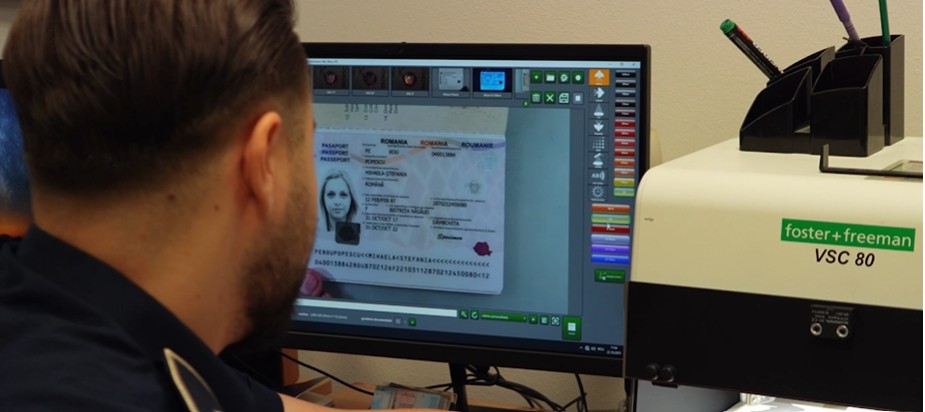
To prevent and combat documentary fraud, the Romanian Border Police uses advanced verification technologies, such as:
- video-spectral comparators that analyze documents in white light, ultraviolet, infrared and through color filters;
- UV lamps;
- portable devices for verifying the authenticity of documents.
A common method at international airports is the “double check-in” method: citizens of non-EU countries purchase two tickets – one to a destination for which they do not need a visa and another to a Schengen country. After entering the transit area, they try to board the Schengen flight, presenting false, forged or other people’s travel documents.
At the end of September 2025, at the Henri Coandă Airport Border Crossing Point, border police detected several people — citizens of Iran, Bangladesh, Syria, and Romania — who presented false passports or counterfeit Romanian identity cards.
A significant contribution to the discovery of these cases is made by officers from contact points and centers operating at the Romanian borders, who promptly verify suspicious documents through international cooperation channels.
In all cases where persons resorting to such methods are detected – using false or falsified travel documents – the border police interrupt the person’s journey, while also drawing up the preliminary documents for the commission of the crimes committed (e.g. forgery, use of forgery, material forgery in official documents or complicity in the commission of this crime, attempted illegal exit/entry, etc.), the penalty provided by the legislation for these crimes being between 3 months and 5 years in prison.